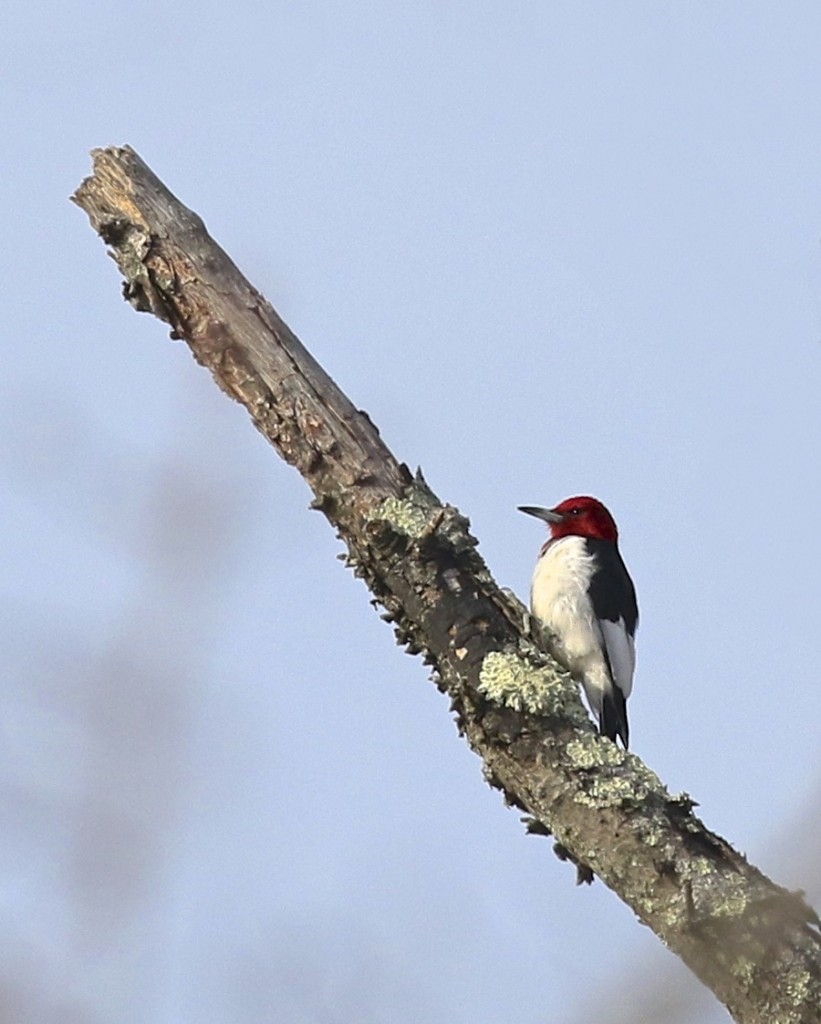
~An adult Red-headed Woodpecker at Fancher Davidge Park, 3/24/16.~
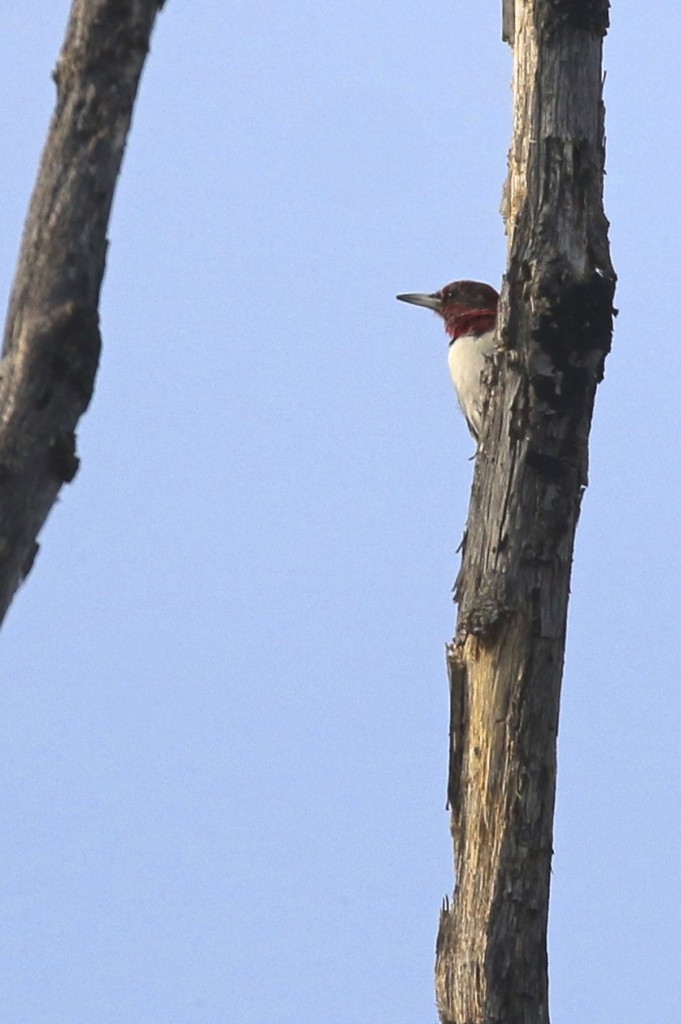
I received a text from Karen Miller while I was at work today; she and Bruce Nott had relocated two RED-HEADED WOODPECKERS (one adult and one juvenile) at Fancher Davidge Park in Middletown, New York. The birds were originally located by Gef Chumard, who birds the park on a regular basis. I talked to Karen on my way home and she provided details, which helped me find the park and the spot pretty easily. I parked and headed down the Nature Observation Trail, which leads to a rather large and beautiful swamp. I was there for about twenty minutes, I hadn’t had any luck, when Gef showed up. He showed me a tree where he had seen one of the birds on a couple of occasions, and while we were talking I located the juvenile Red-headed Woodpecker on a distant dead tree. Gef had someplace to be, so he left me to it. I eventually located the adult as well, and managed to get some ID photos of both birds. It was great fun to bird in a new spot, and the place was loaded with birds (I had 29 species for the afternoon).
Huge thanks to Karen for the heads up, and congratulations to Gef on a great find!
~A juvenile Red-headed Woodpecker at Fancher Davidge Park, 3/24/16. According to the Crossley ID Guide, the juvenile “molts through the winter so that by spring it is similar to adult, but often slightly duller…” ~
~Another highlight of the afternoon – a Brown Creeper which avoided having its photo taken as much as it could. Fancher Davidge Park, 2/24/16~
~A single Bonaparte’s Gull with 4 Ring-billed Gulls in the foreground at Wickham Lake, 3/15/16.~
QUICK POST: Huge thanks to Bruce Nott who texted me to let me know he had located a BONAPARTE’S GULL at Wickham Lake earlier today while I was at work. I ran for the bird after I got out and luckily it was still around, floating in the distance among a large group of Ring-billed Gulls.
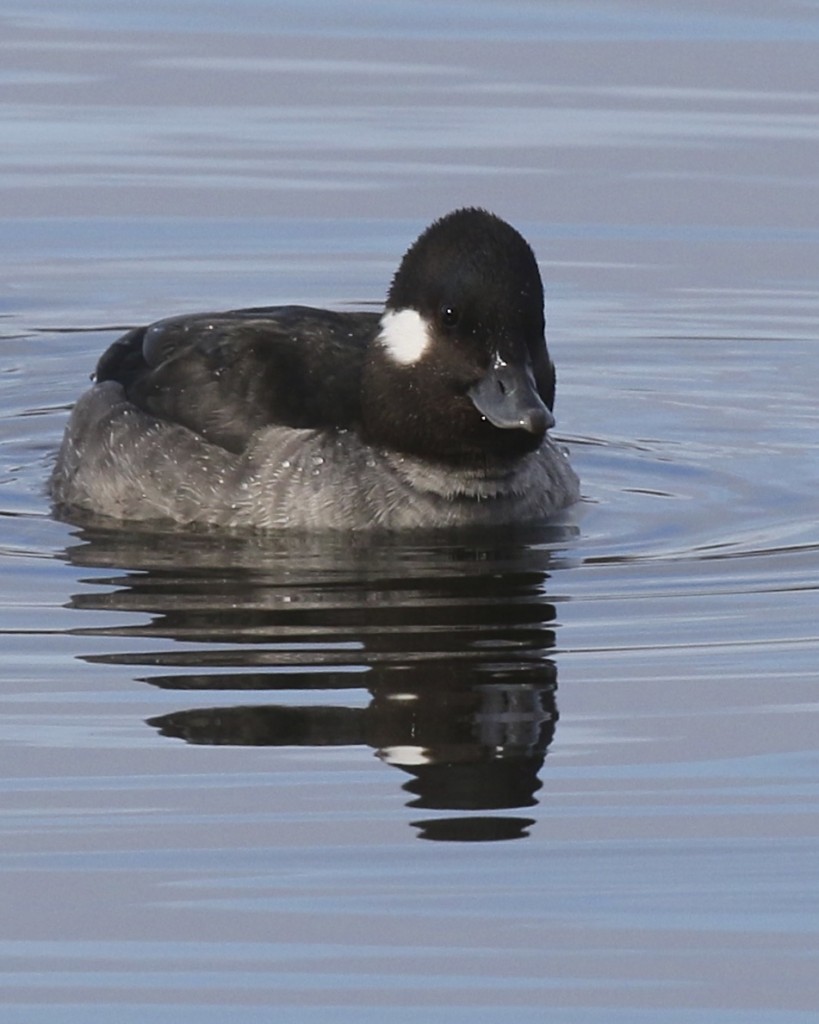
~While I was trying to photograph the BOGU, I heard a call that I hadn’t heard before. I looked around and saw that it was from a female Bufflehead. I had photographed her with a male a little bit earlier, but when she called the male was nowhere to be seen. Moments later the male flew in and settled right next to the female. Wickham Lake, 3/15/16.~
~This is the best I could do! Barrow’s Goldeneye at Glasco Mini Park in Ulster County, NY 3/12/16.~
After some uneventful early morning local birding, I drove up to Glasco, New York in Ulster Count to meet up with Linda Scrima and Maria Loukeris. We were going for the BARROW’S GOLDENEYE which had been reported at Glasco Mini Park in recent days. We located the bird fairly quickly far out in the Hudson River; it was keeping company with several Common Goldeneyes and a single scaup, which I’m pretty sure was a Greater Scaup. The birds were really quite distant, and additionally it was tough to get good looks because the water was quite choppy and the birds were diving regularly. But, we were patient and eventually we all got good looks in the scope and even managed to take some documentary photos, which was no small feat. One of us would look in the scope and call out when and where the Barrow’s surfaced while the others clicked away, hoping for the best. In spite of the distance and maybe because of the challenge of trying to get good looks, I really enjoyed going for this bird. The Barrow’s Goldeneye was life bird number 345 for me and my 259th New York State bird.
Linda and Maria continued north to do some Adirondack birding and I headed over to the Shawangunk Grasslands National Wildlife Refuge to meet up with Kyle Dudgeon to try our luck with Northern Harriers and Short-eared Owls. Unfortunately, it was a slow afternoon and the then the owls got up on the late side so we did not do very well with photos at all. Still, it was nice just to be out, especially for Kyle who has been away at school since January.
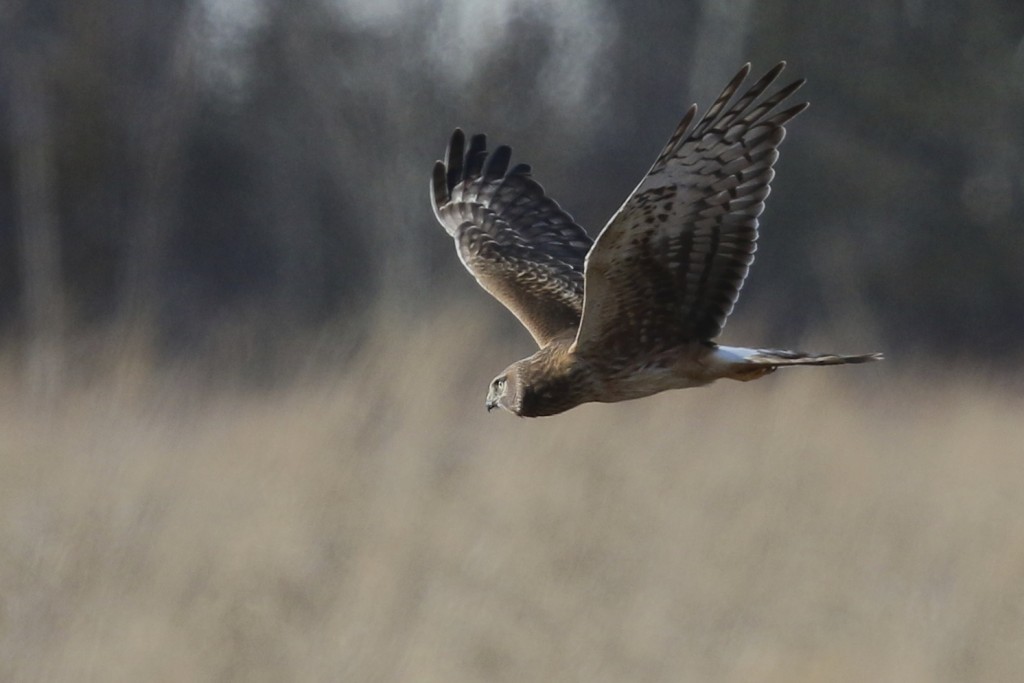
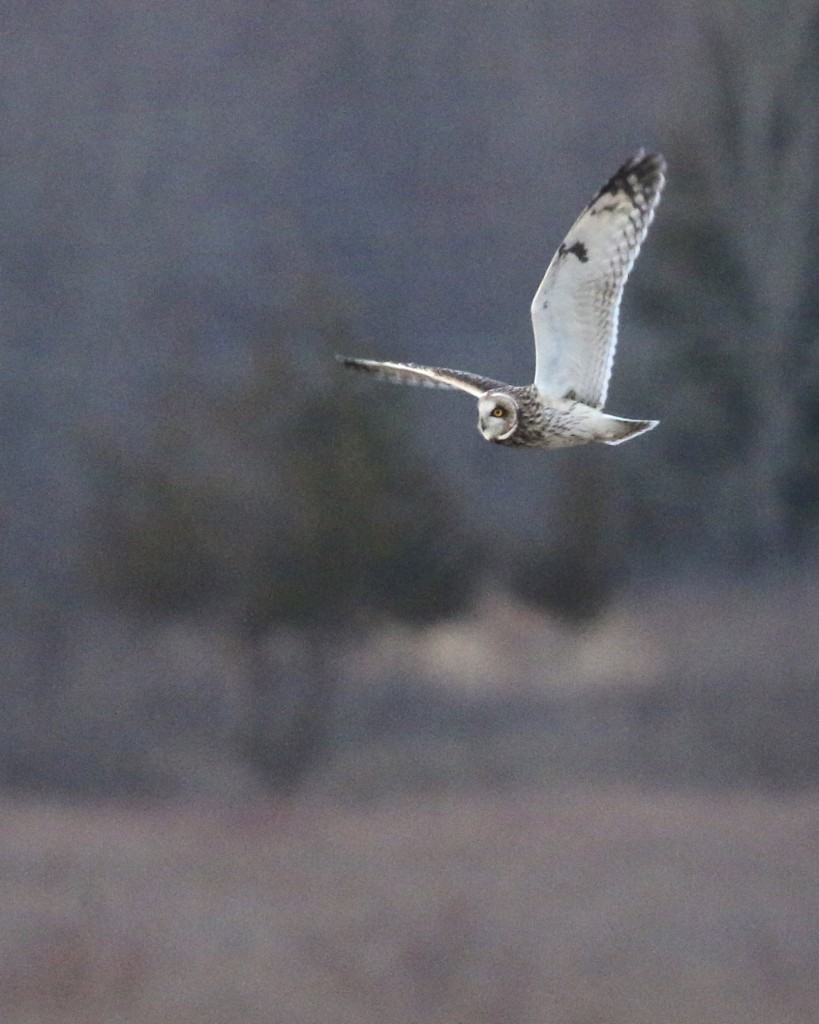
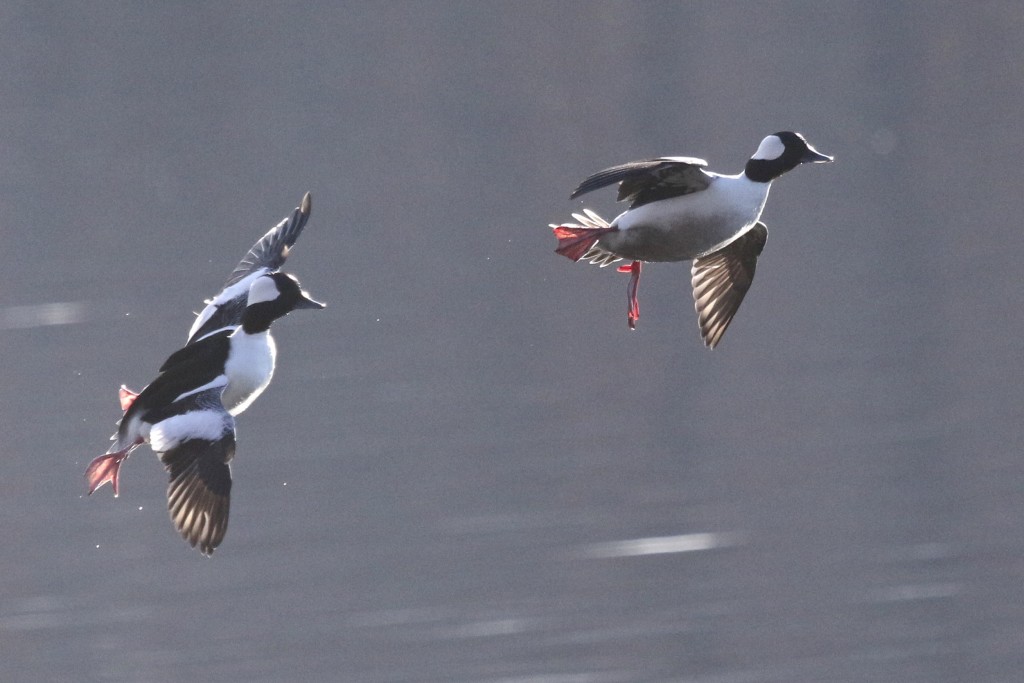
~Northern Harrier with a FULL crop, Shawangunk Grasslands NWR, 3/12/16.~~A super grainy shot of a Short-eared Owl in flight. Quite a difference from last weekend! Shawangunk Grasslands, 3/12/16.~~The only thing good about backlit Buffleheads is glowing pink feet! Glenmere Lake, 3/12/16.~~I really enjoyed watching these Buffleheads – six males were vying for the attentions of a single female. They put on a show! Glenmere Lake, 3/12/16.~
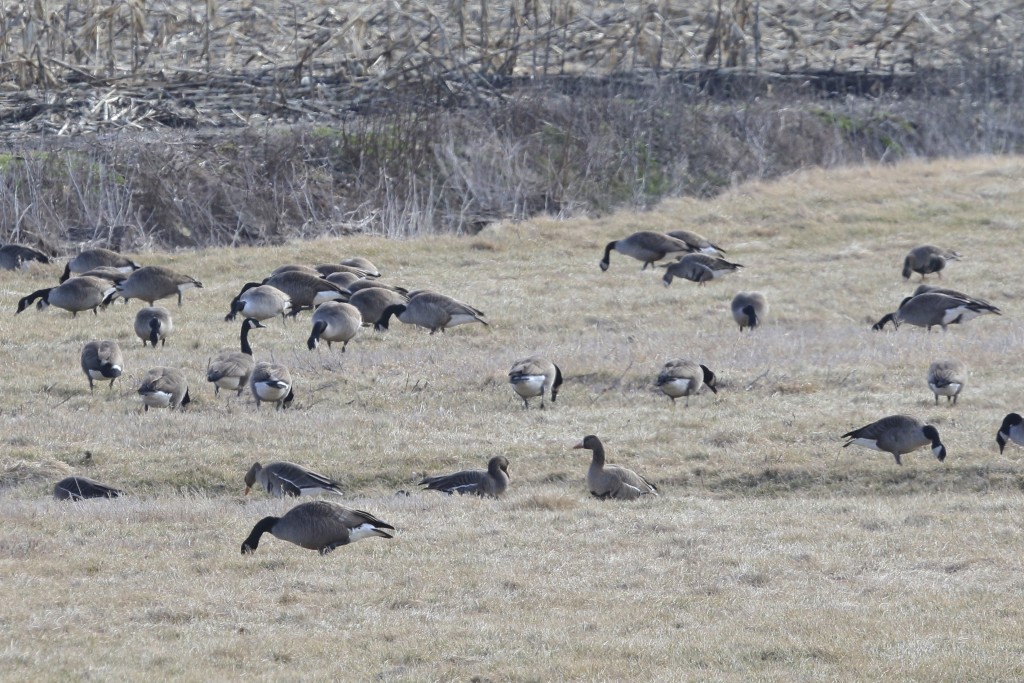
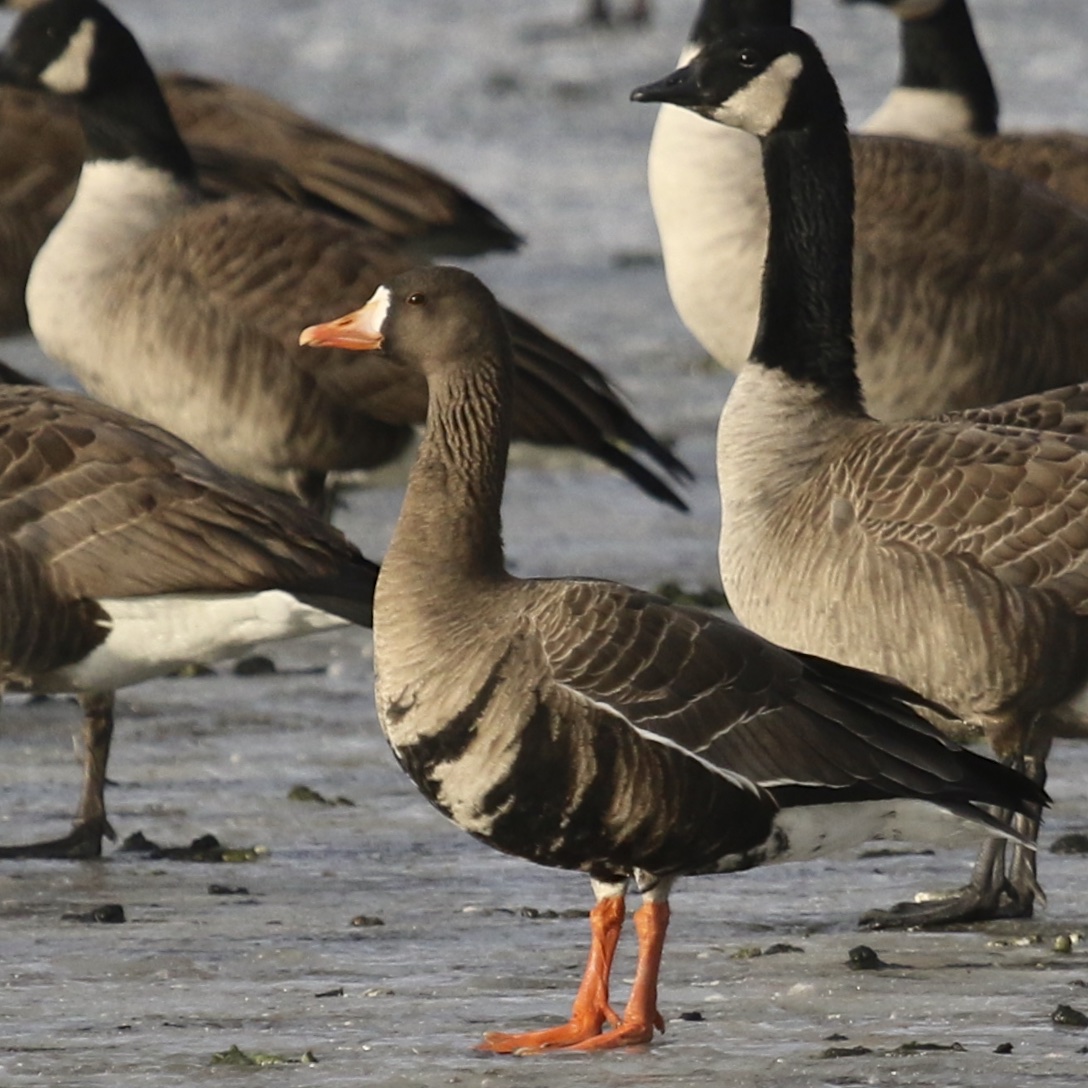
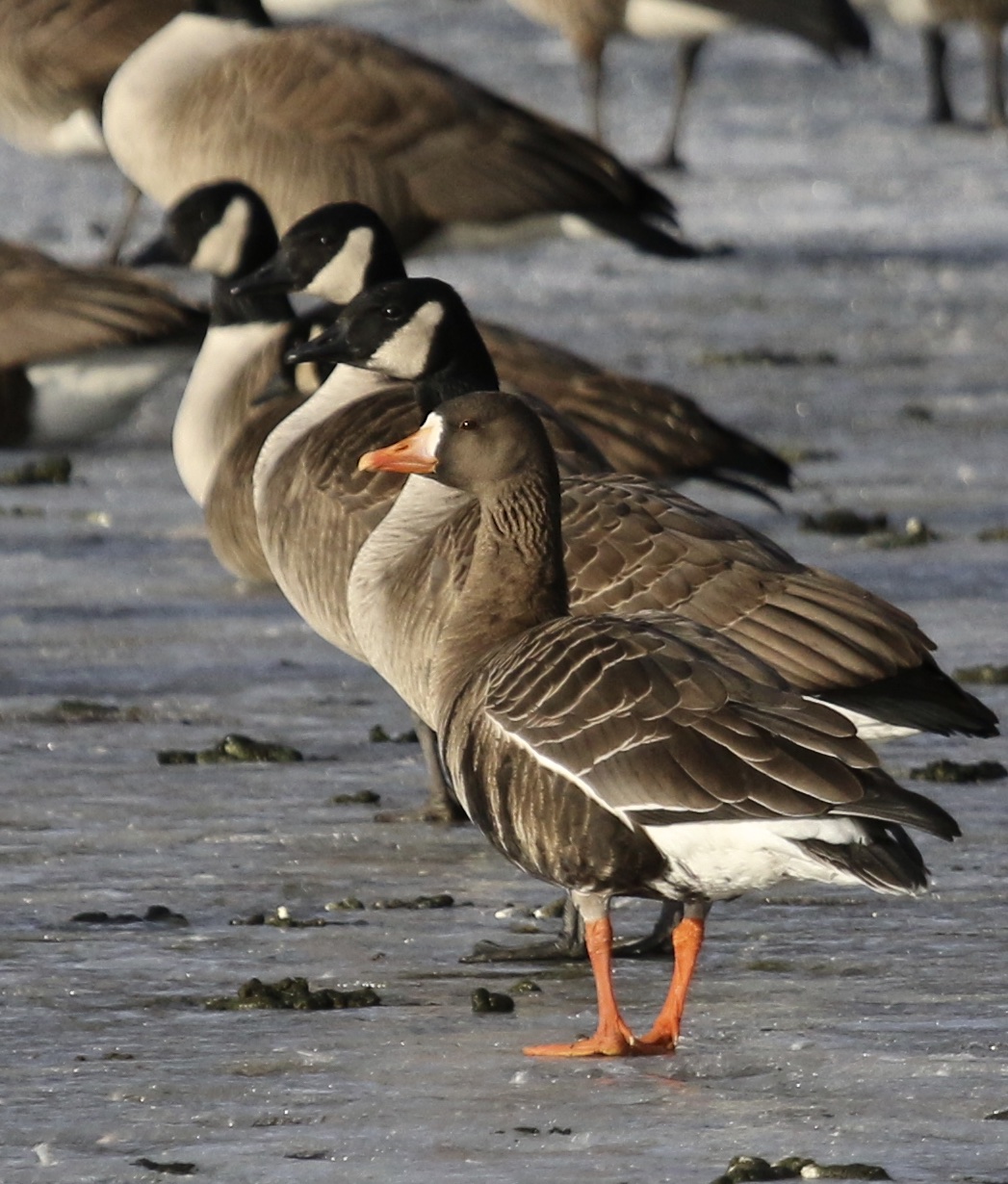
~Two of seven Greater White-fronted Geese at Pierce Circle in the Black Dirt Region, 3/6/16.~
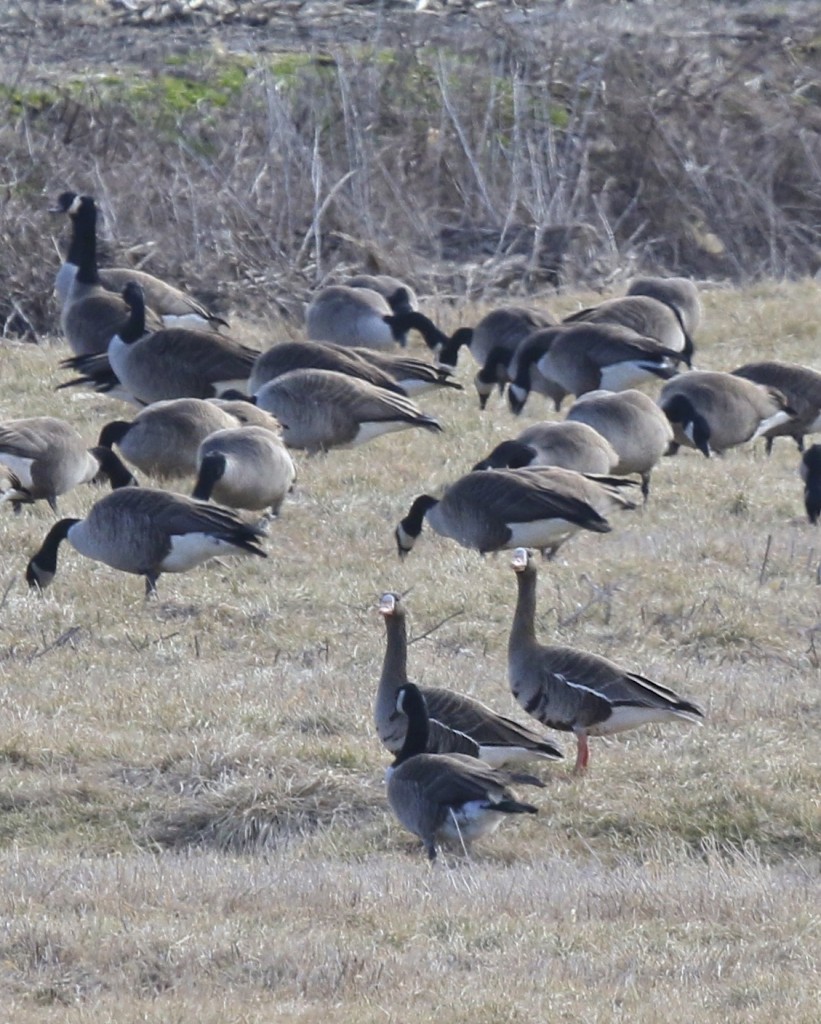
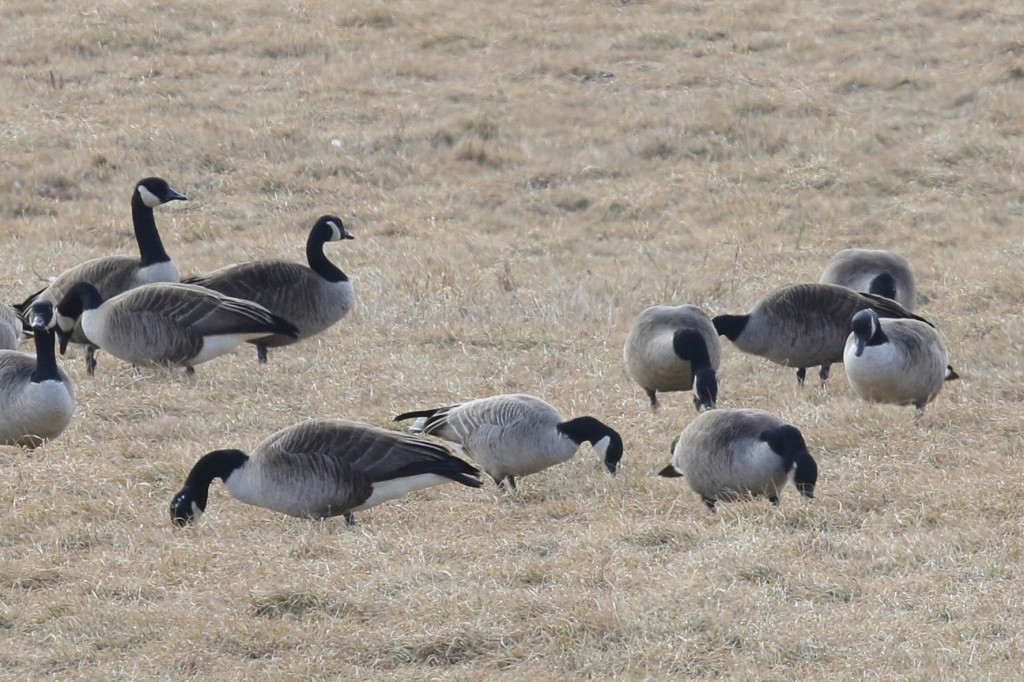
One of my first stops this morning was certainly the best of the day. I stopped to check out a group of approximately 500 Canada Geese located on Pierce Circle. I was not optimistic that I would find anything good among the Canadas, first of all because there were not very many birds, and second because the birds were close enough to sort through with binoculars (no scope needed!). I perked up when I located one, then two, then four GREATER WHITE-FRONTED GEESE! Then another – make it five! I put the word out, continued looking and found a sixth GWFG. Maria Loukeris must have been in the area because she joined me pretty quickly. Shortly after her arrival, I located the SEVENTH GWFG! Scanning left to right, a group of four, then a pair, and then a single Greater White-fronted Goose sitting in the field on its own. Also present was a single Cackling Goose, close enough for some decent, if backlit photos.It was very exciting, and I particularly enjoyed when the group of four flew into the next field calling the whole time. After a few minutes, they rejoined the flock. It was hard to tear myself away from such great birds, but eventually I did.
I spent the rest of my morning and early afternoon in southern Orange County, but I did not have any additional notable sightings. I will mention that there is a huge group of Common Mergansers at Wickham Lake – I estimate 900 birds. The forecast for the afternoon and evening was clear skies, so I decided to try my luck at the Shawangunk Grasslands NWR…
~This photo shows six of the seven Greater White-fronted Geese, can you find them? Pierce Circle, 3/6/16.~~Cackling Goose at Pierce Circle, 3/6/16.~
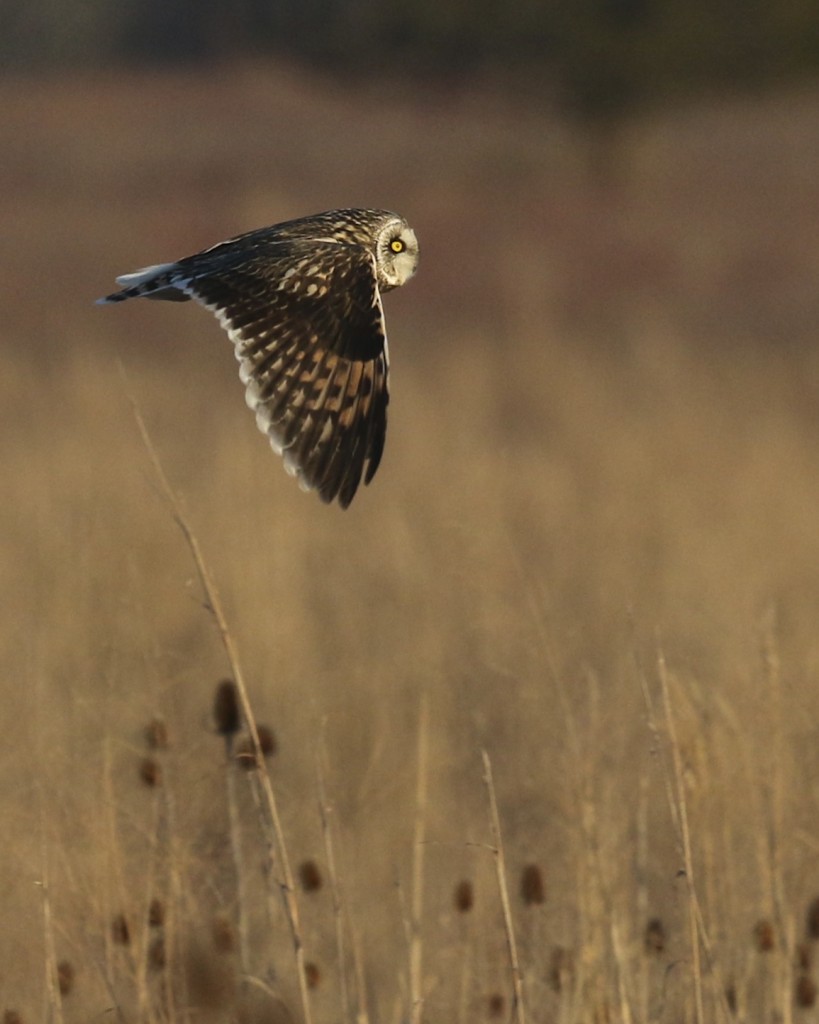
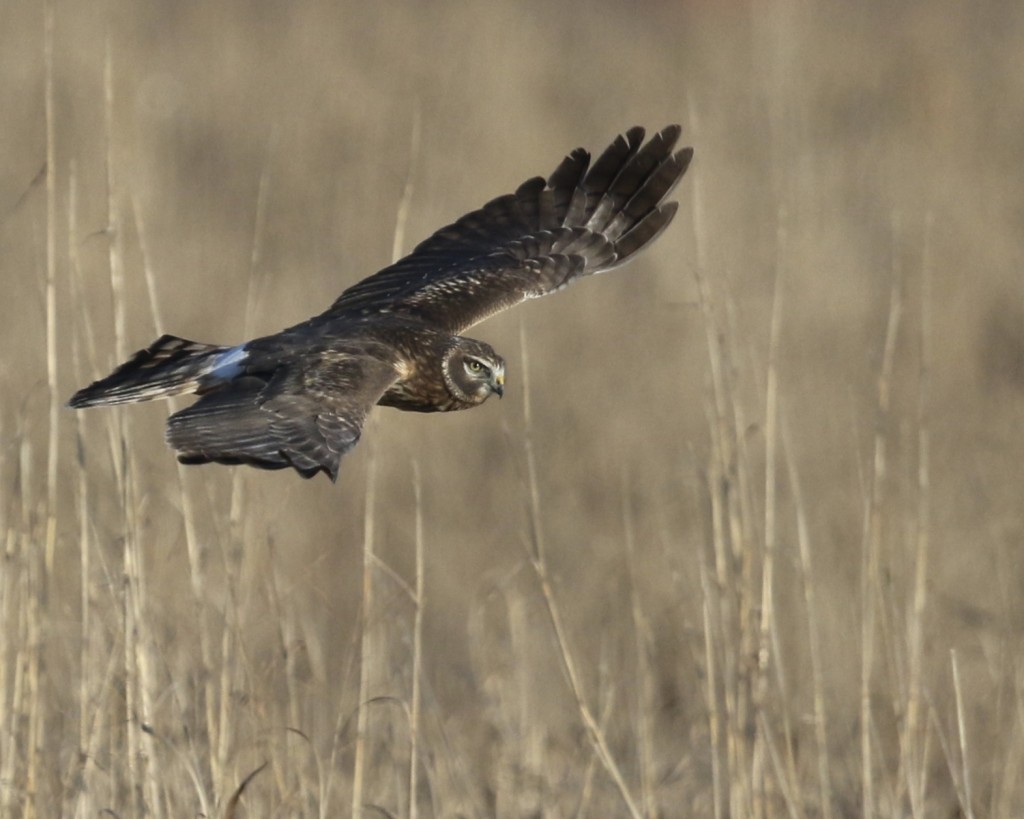
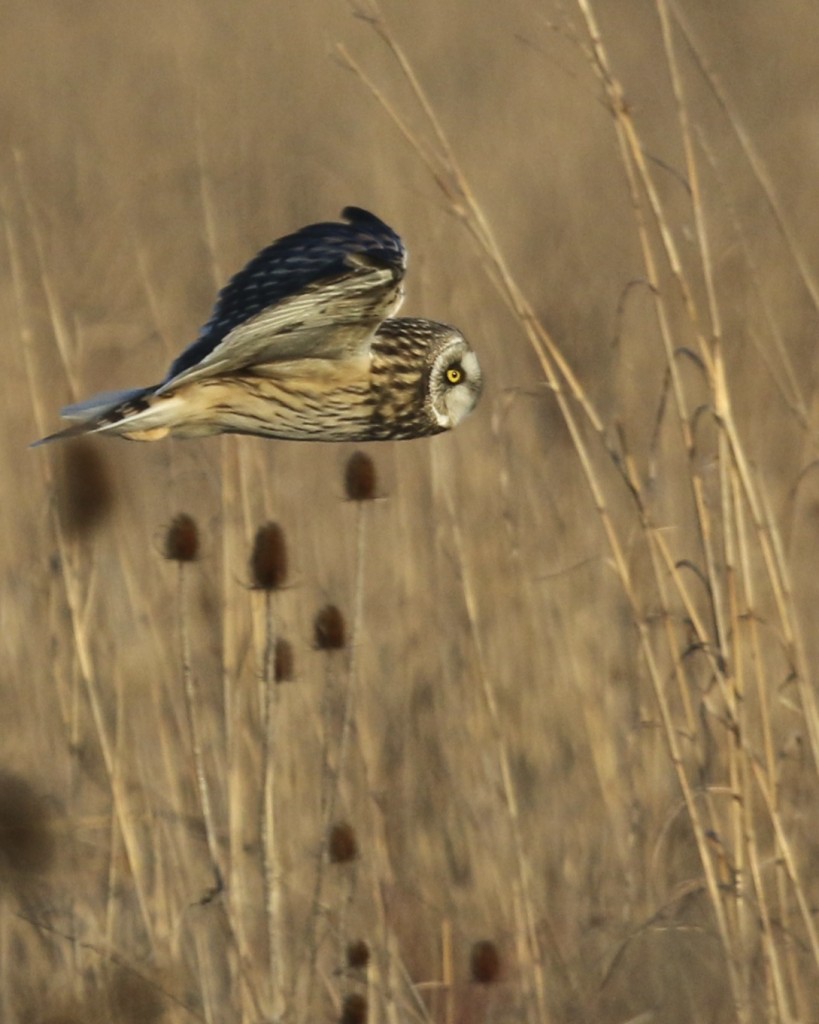
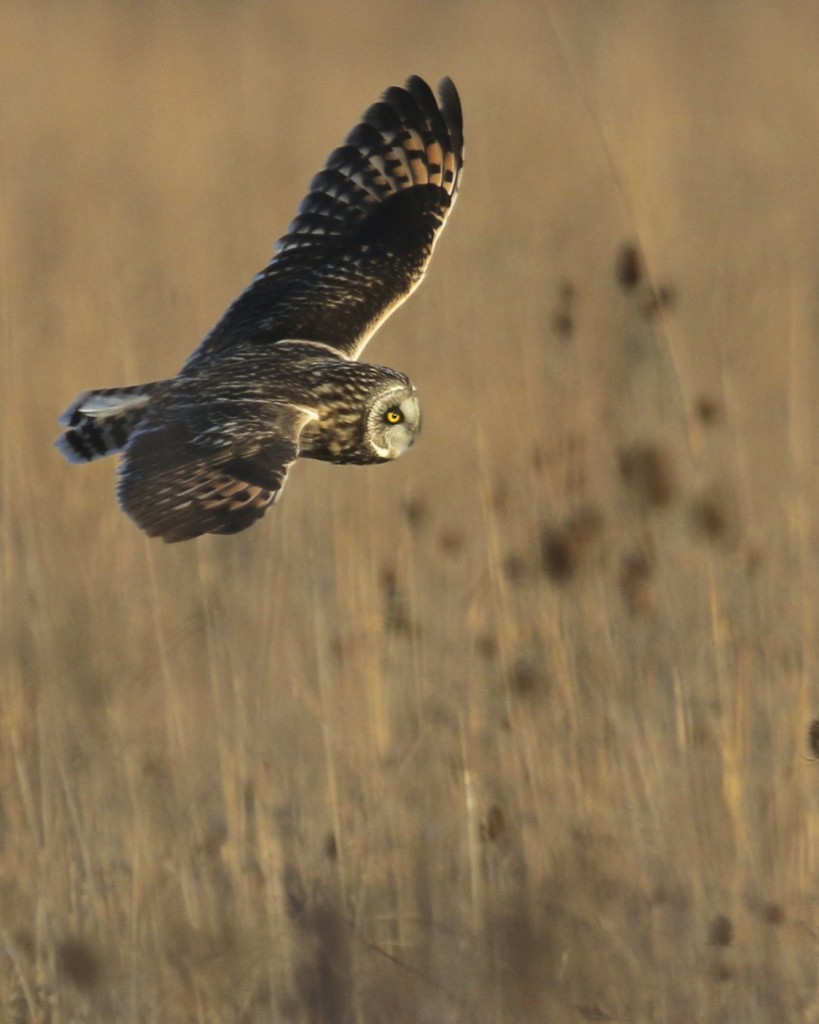
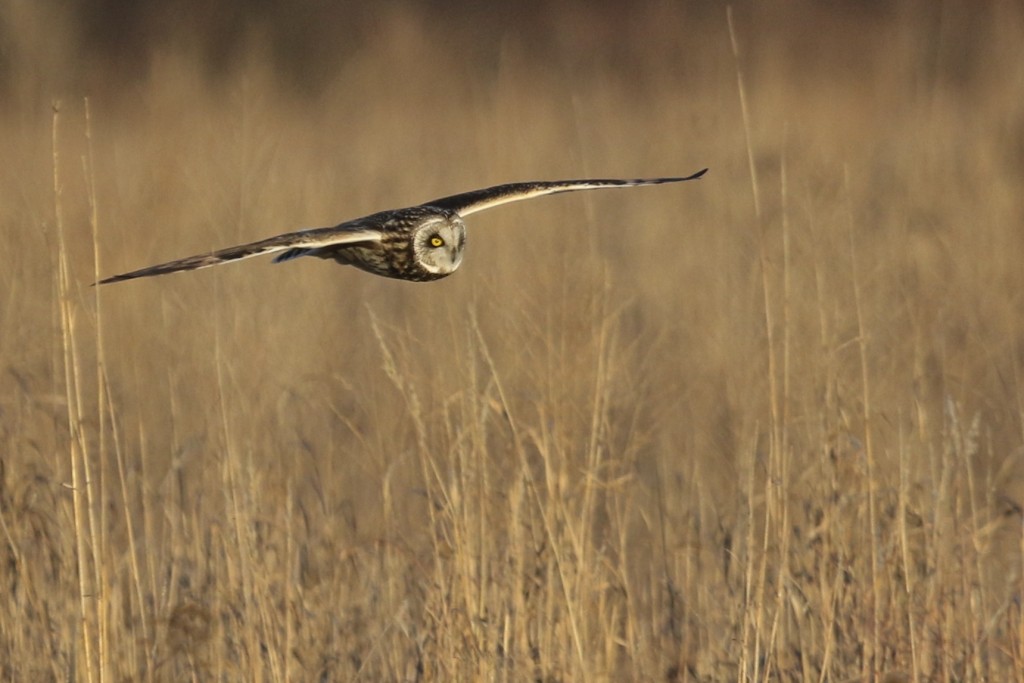
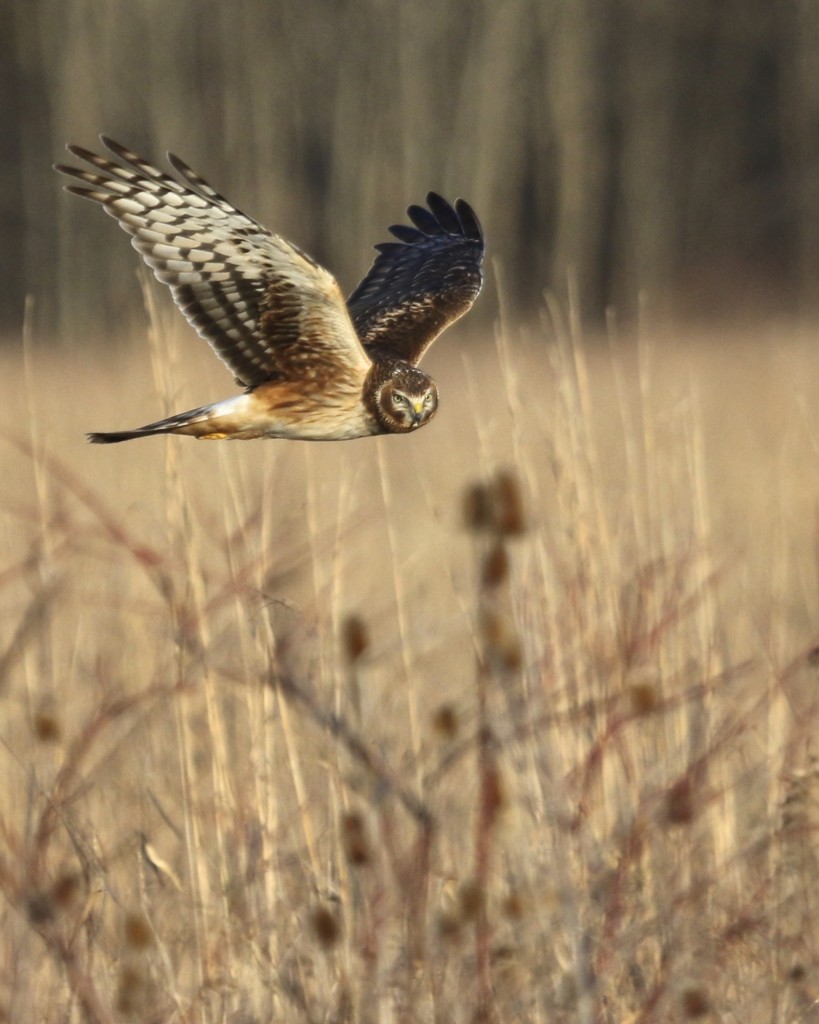
…and I got lucky! The Short-eared Owls got up early (around 5:00), the light was fantastic, and the birds flew close enough for some decent photos. I’ve said it many times before, but you cannot beat photographing SEOWs from the photo blinds out at the Grasslands. I got there early and waited a good while with very few birds. There were several Northern Harriers foraging the throughout the reserve and once in a while they would get close enough for photos, but there were large chunks of time with no birds at all. It was all totally worth it, of course, when the owls got up and put on their show. I counted a total of 5 Short-eared Owls, 7 Northern Harriers, and 2 Red-tailed Hawks. And I also saw my first Eastern Meadowlarks of the year. What a great day of birding!
~Short-eared Owl in flight at the Shawangunk Grasslands NWR, 3/6/16.~~A nice look at a Northern Harrier, Shawangunk Grasslands NWR 3/6/16.~~A SEOW shoots through the grasses at the reserve. Shawangunk Grasslands, 3/6/16.~~I love getting a good look at the top side of these birds. Short-eared Owl at Shawangunk Grasslands, 3/6/16.~~SEOW in flight, Shawangunk Grasslands, NWR 3/6/16.~~NOHA giving a look in my direction, Shawangunk Grasslands NWR, 3/6/16.~
Third time’s a charm. This afternoon I went for the BULLOCK’S ORIOLE that has been visiting a homeowner’s feeder in Ulster County, and after two unsuccessful previous attempts, I finally got to see the bird. I was joined by a Connecticut birder and we were able to locate the bird in a nearby tree relatively quickly. It fed on the far side of the suet feeder for a short time and then flew into a large evergreen where I lost track of the bird. Moments later, a Sharp-shinned Hawk shot through the yard and scattered all the birds. The Connecticut birder moved on; I stayed and the oriole returned one more time to the yard, perched for a few moments in a tree, fed very briefly and flew off. I was happy that I stayed because I was able to get a couple decent shots when the bird perched in the tree. The bird was not as large as I was for some reason thinking it would be, and the yard is mostly in shade so the bird also did not stand out as much I would have thought. It was and my 345th life bird and my 258th bird in New York State.
The homeowner welcomes birders to come try for the bird – email me for the address if you want to go for it (it has been published before, but I feel strange putting the address here). Please ring the doorbell and ask for permission and he will tell you where to best view the feeders.
~I enjoyed seeing this Red-tailed Hawk; I pulled over to listen for songbirds and then saw it sitting low in the woods. Port Jervis, NY 2/21/16.~
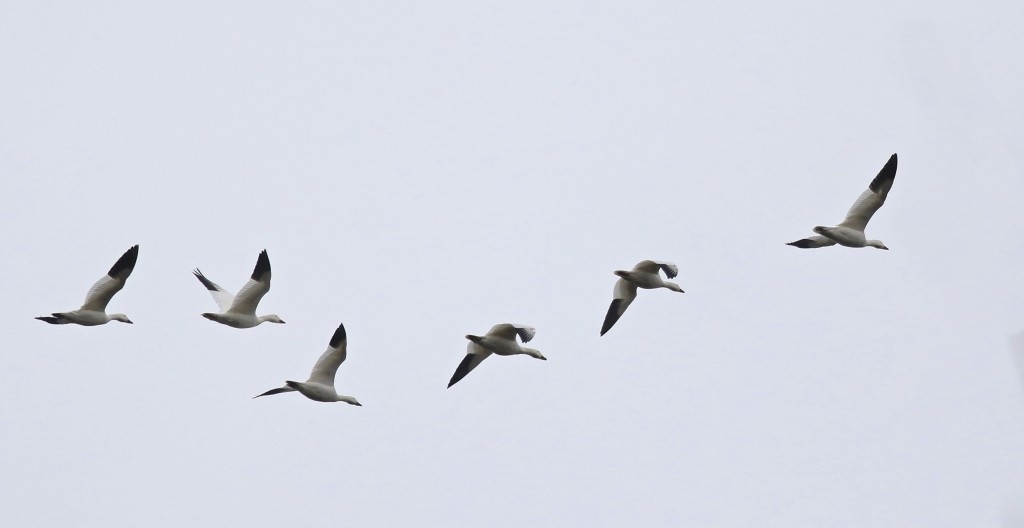
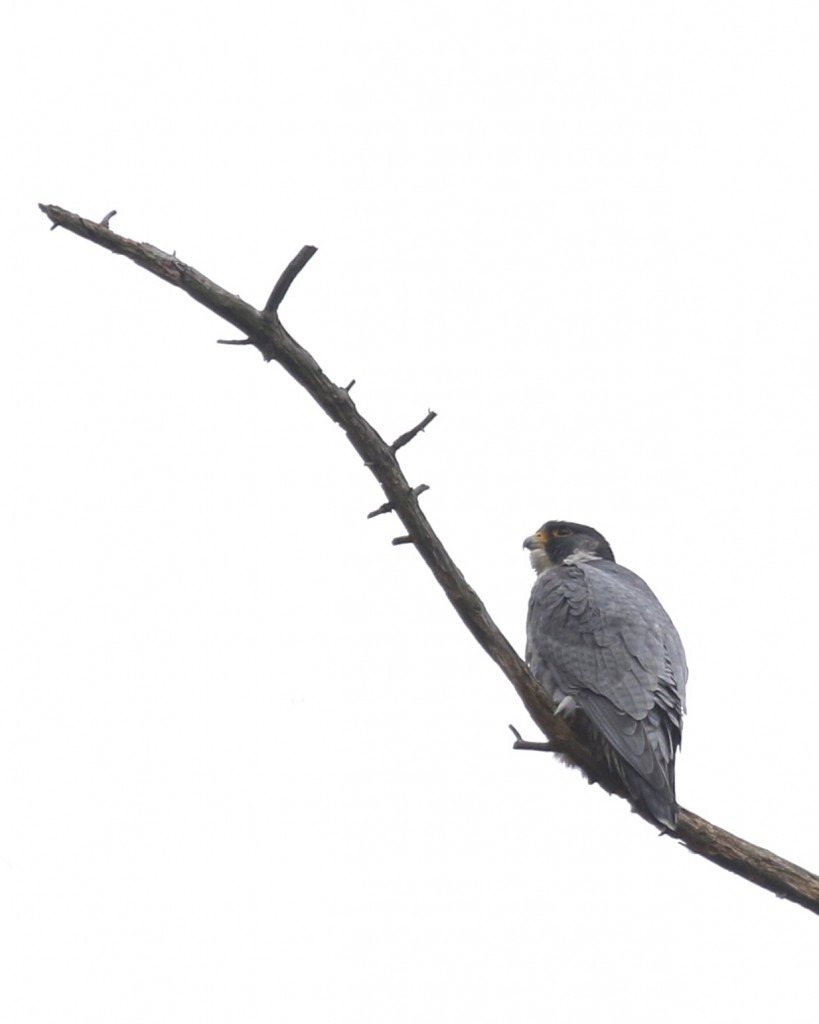
After a disappointing Saturday of birding, I did much better on Sunday. I started the day in Port Jervis, hitting several spots. I added four birds to my Orange County year list, including two birds that I feel are pretty good birds for the county: GREATER SCAUP and COMMON GOLDENEYE. The other two birds were a Peregrine Falcon and a small flock of Cedar Waxwings. The highlight of the morning, however, was first hearing and then seeing a skein of approximately 75 SNOW GEESE fly overhead as I walked down a trail. This got me thinking about the possibility of finding some Snow Geese in the black dirt, which would be my next stop.
~One of my first birds of the day – Greater Scaup at Laurel Grove Cemetery in Port Jervis, NY 2/21/16.~~An adult Bald Eagle flies over the Delaware River, Port Jervis NY, 2/21/16.~~Nice bird to see, a single Common Goldeneye, Laurel Grove Cemetery 2/21/16.~~SNOW GEESE! Nice flyover of a skein of SNGOs in Port Jervis, NY 2/21/16.~~Peregrine Falcon perched high over the Delaware River, Port Jervis NY, 2/21/16.~
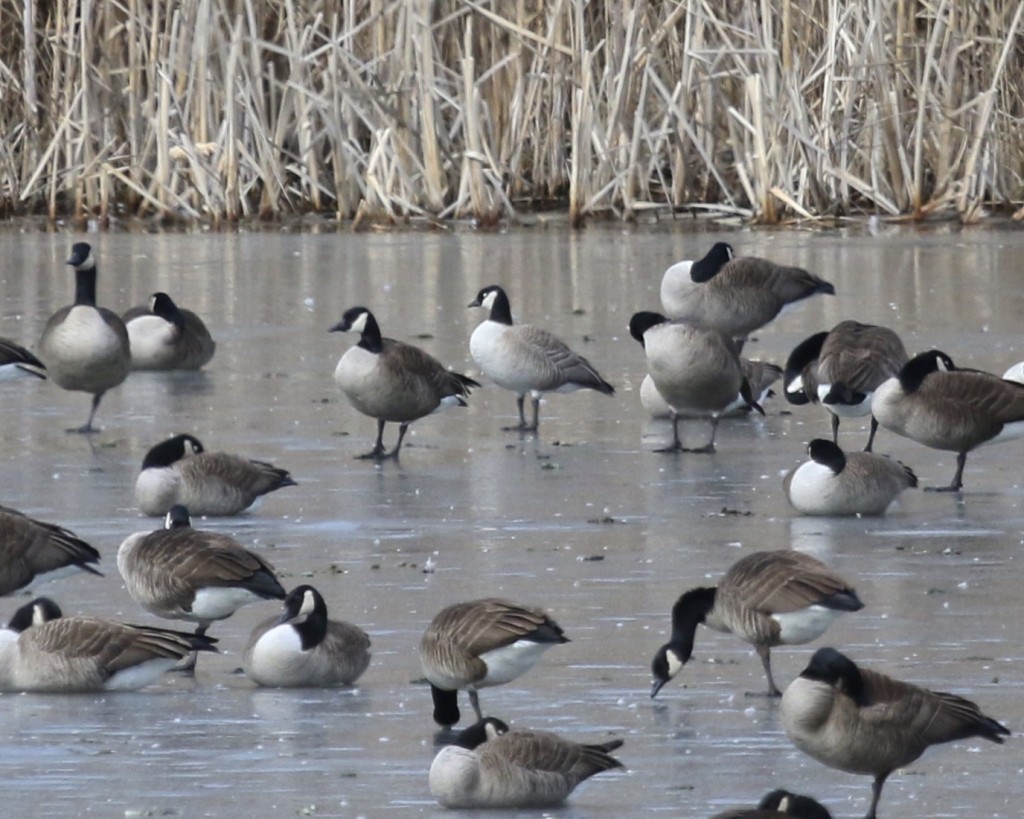
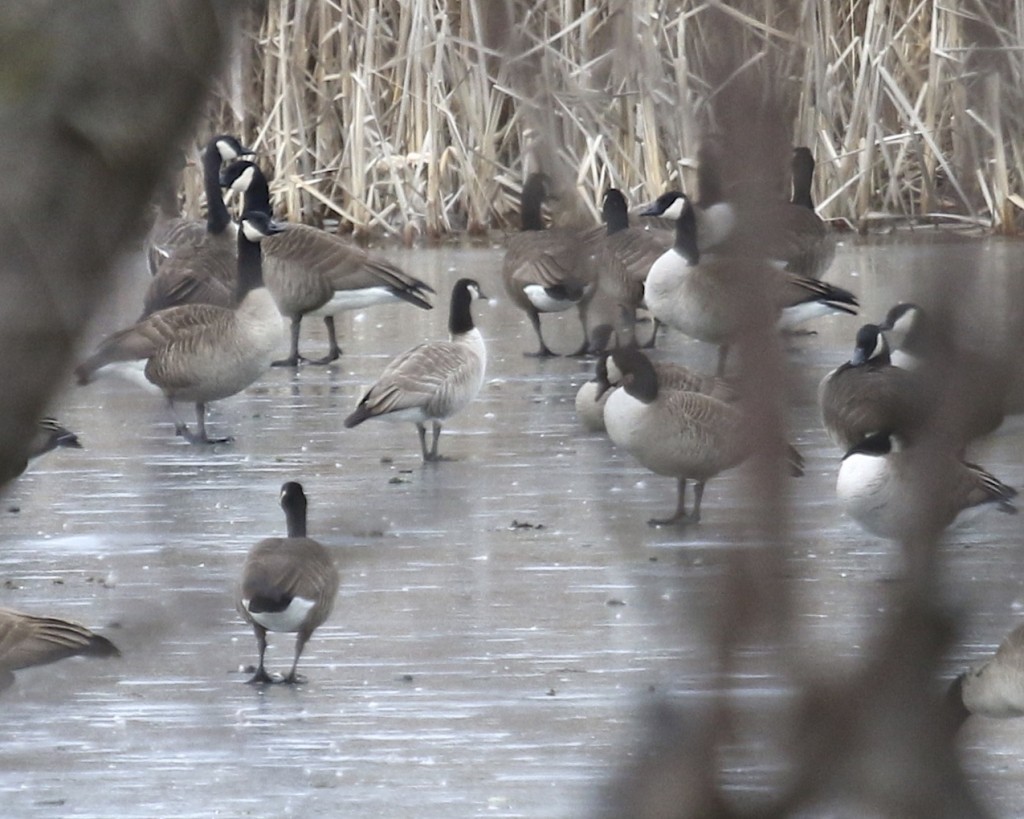
I made my way out to the Black Dirt Region, where I met up with Bruce Nott and Linda Scrima. We sifted through a nice sized group of Canada Geese and found some gems: 6 Snow Geese, 1 GREATER WHITE-FRONTED GOOSE, and I was finally able catch up with a CACKLING GOOSE (there have been many reports in the region). Afterwards, Bruce and I continued to the Pine Island Turf Nursery, in search of pipits. We didn’t have any luck with the pipits, but we had a good sized flock of Horned Larks and a good collection of songbirds that provided some photo ops. It was a really good day of birding for me, something that I certainly needed.
~Cackling Goose in the black dirt 2/21/16. I like this for a Cackling because of the smaller size, small bill, shorter neck, and blocky head. ~Terrible photo here, but I included it because I think it shows the size of this bird better than the photo above. Cackling Goose, 2/21/16.~~A Red-bellied Woodpecker shows off its namesake (and it’s tongue!). Pine Island Turf Nursery, 2/21/16.~~That’s a blue Eastern Bluebird! Pine Island Turf Nursery, 2/21/16.~
~Wow! Greater White-fronted Goose in the Black Dirt Region, 1/29/16.~
I love getting word of a good bird while I’m at work. Well, I love it and I hate it. It’s great because it’s exciting and something to look forward to after work, but it can be terrible too because the day inevitably passes very slowly and there is always the chance that the bird will move on. This morning I received a text from John Haas – he had a GREATER WHITE-FRONTED GOOSE among a couple thousand Canada Geese at Turtle Bay in the black dirt, which was very exciting to me! As expected, the day did drag on, and of course, as I was leaving I received word from Linda Scrima that after spending most of the day at Turtle Bay, all the geese had lifted up. She had scoured all the regular black dirt geese locations and was unable to locate any large groups of geese. I could think of one other location where the birds could be located, but it was private property. Linda met me at the location, and with the homeowner’s permission we were able to relocate the bird and get some good photos too!
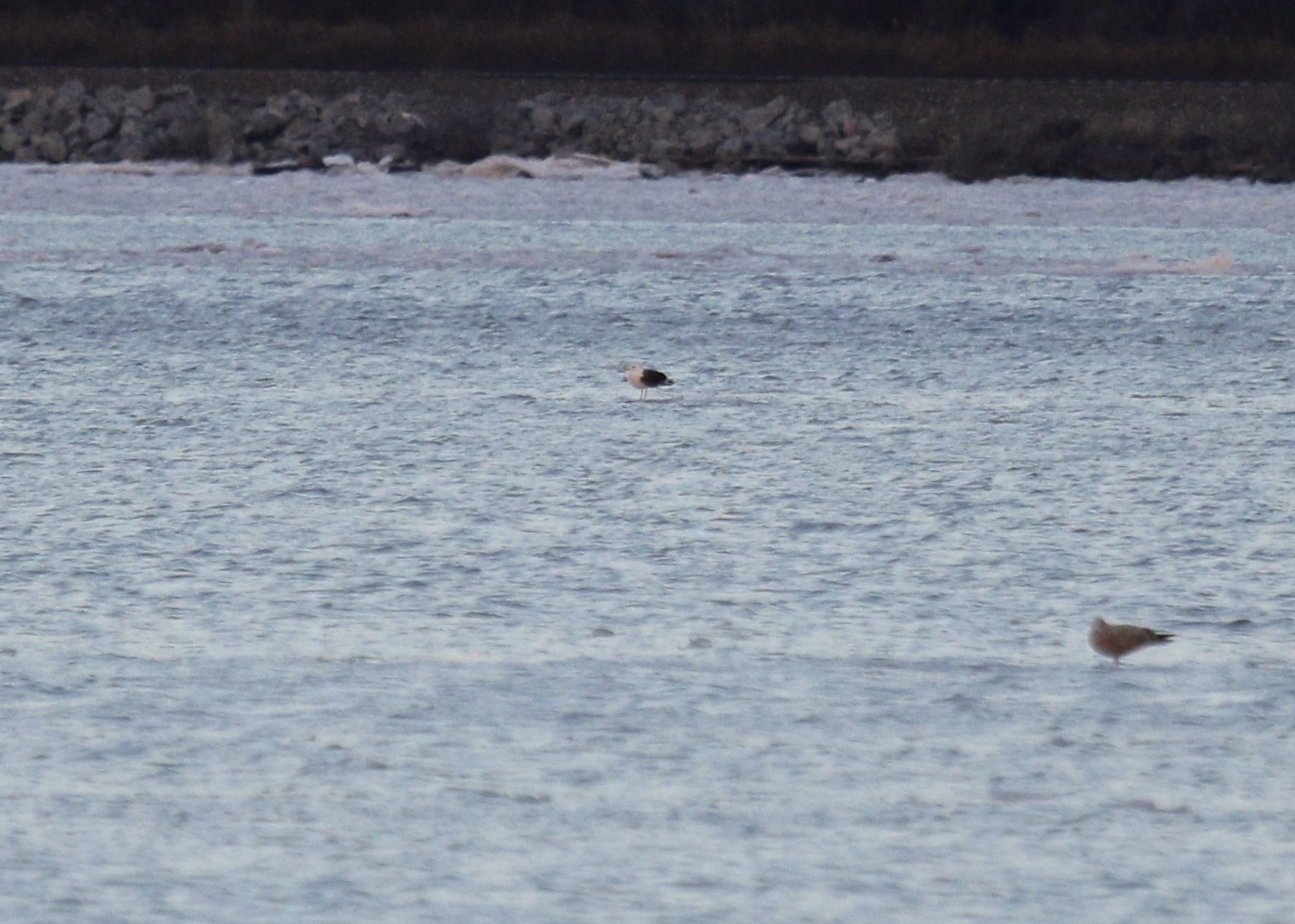
My exciting evening of birding didn’t end there. I had been in contact with Bruce Nott and he was at the Newburgh Waterfront looking for gulls. I contacted him after leaving the GWFG and he was on a LESSER BLACK-BACKED GULL, presumably the same bird John Haas had located earlier in the week (that guy’s having a pretty good week!). I made my way over to Newburgh and when I arrived, Bruce and Ajit and Liza Antony all had the bird in their scopes. I hopped out of the car and took a good look at the bird in both scopes before going back to the car for my own scope. They told me how they had lost the bird but relocated it while I was in transit! What a great afternoon and evening of birding!
~They all lined up nicely for this photo, Greater White-fronted Goose up front, of course! Black Dirt Region, 1/29/16.~~I don’t even know if this even qualifies as a documentary photo – Lesser Black-backed Gull at the Newburgh Waterfront, 1/29/16. Click here to see a decent shot I got of a LBBG last March at this same location.~
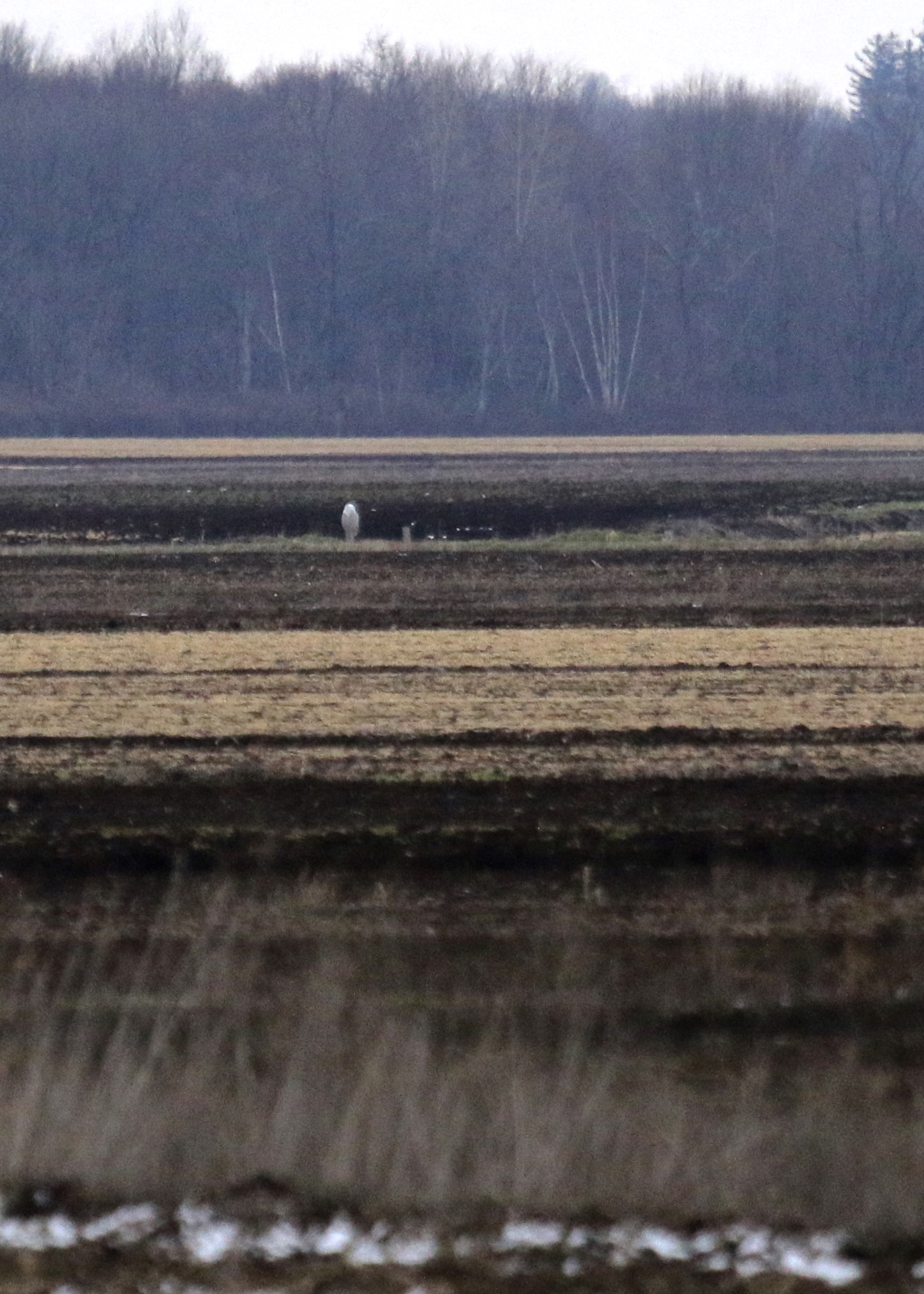
~Wow!, Snowy Owl in the Black Dirt Region, 1/14/16.~
I met Kyle out in the Black Dirt this evening after work to try for some raptors – Northern Harriers and Short-eared Owls were the goal. I was pleasantly surprised when I spotted a large white bird fly over a field in the distance, being chased by crows – SNOWY OWL!!! We immediately jumped out of the car and got the bird in the scope to find it had perched on a distant small post in a field. We watched the bird as it was harassed by both Northern Harriers and Short-eared Owls; it flew one time and found a new perch, but shortly after returned to its original perch. The bird was very distant, so pics were tough; the above is from the camera, and the shot below is with the iPhone through the scope. It was a super exciting night! Lifer Snowy for Kyle and my first one in a couple of years!
***If you go for this bird, please be respectful of the locals in the black dirt. Many roads are private and not public and shouldn’t be used without permission. Farmers are still working so please keep all roads clear and let them work. As a general rule, for me, if there is any sort of work going on I leave the area.***
~iPhone shot through the spotting scope – Snowy Owl in the Black Dirt, 1/14/16.~
I blame the insomnia. I do. I really struggled to sleep last night and ultimately only got a very little bit of shut-eye. Which made for a really tough morning, a difficult workday, and some bizarre birding.
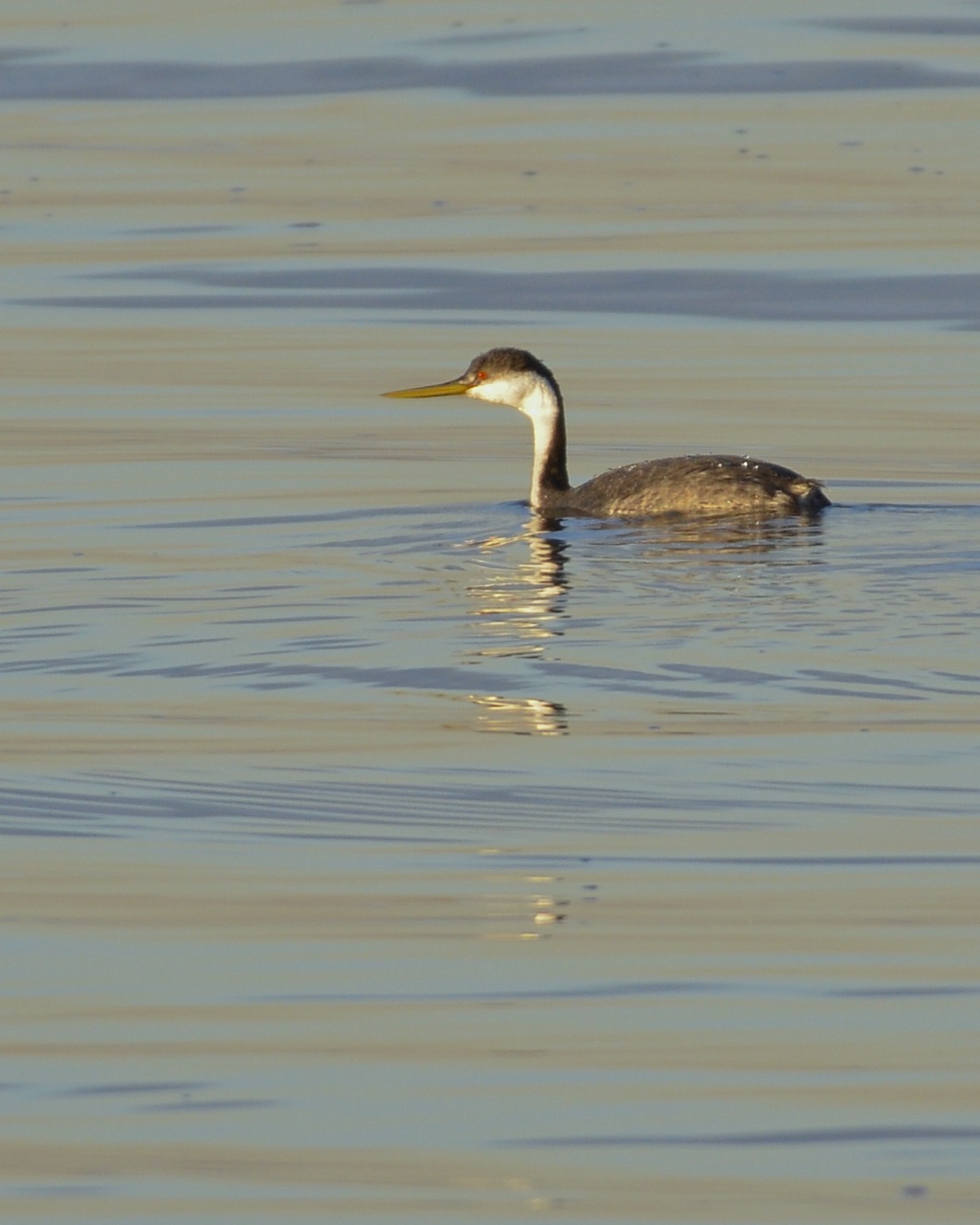
Just before noon, I received a phone call from John Haas – he had a WESTERN GREBE at Piermont Pier! When I got out of work I headed straight to Piermont and arrived with plenty of beautiful light. I parked at the beginning of the pier, and as I walked towards where the bird had been seen, Bob Senerchia pulled alongside me and gave me a lift the rest of the way, explaining that there was plenty of parking further up. Maria Loukeris and Christopher Takacs were both there and photographing the bird, which was in perfect evening light and not very far out (I’ve included one of Maria’s shots below). I jumped out of Bob’s car and pretty much immediately started to take photos… I looked at my camera and saw some awful words: No Card in Camera. Ugh, no way, not today. I must have a spare back in the car! Bob let me borrow his car, which is a Prius which apparently you need a special degree to drive. I finally figured out out how to get it into gear and drove back to my car. With the parking brake on – I thought the beeping was for the seatbelt! I checked my camera bag and of course, no spare card. My heart was broken, but I grabbed my scope and my iPhone adapter and called Bob so he could tell me how to release the brake. I made it back incident-free, and decided to make lemonade out of lemons. I stayed for a good while and enjoyed the bird, what a beauty! I took what photos I could through the scope and shot the above video, which made me happy. When it came time to leave, I took the wrong exit and went across the Tappan Zee Bridge… it’s the insomnia – that’s my story and I’m sticking to it.
Huge thanks to Bob for letting use his car, Maria for her photo, and of course to John Haas for locating the bird and getting the word out.
~WESTERN GREBE at Piermont Pier, 1/716. Photo by Maria Loukeris.~~One more digiscoped shot of the WESTERN GREBE, Piermont Pier 1/7/16.~~iPhone digiscope shot of the WESTERN GREBE at Piermont Pier, 1/7/16.~
~TUFTED DUCK at Lake Capri in West Islip, NY 12/26/15.~
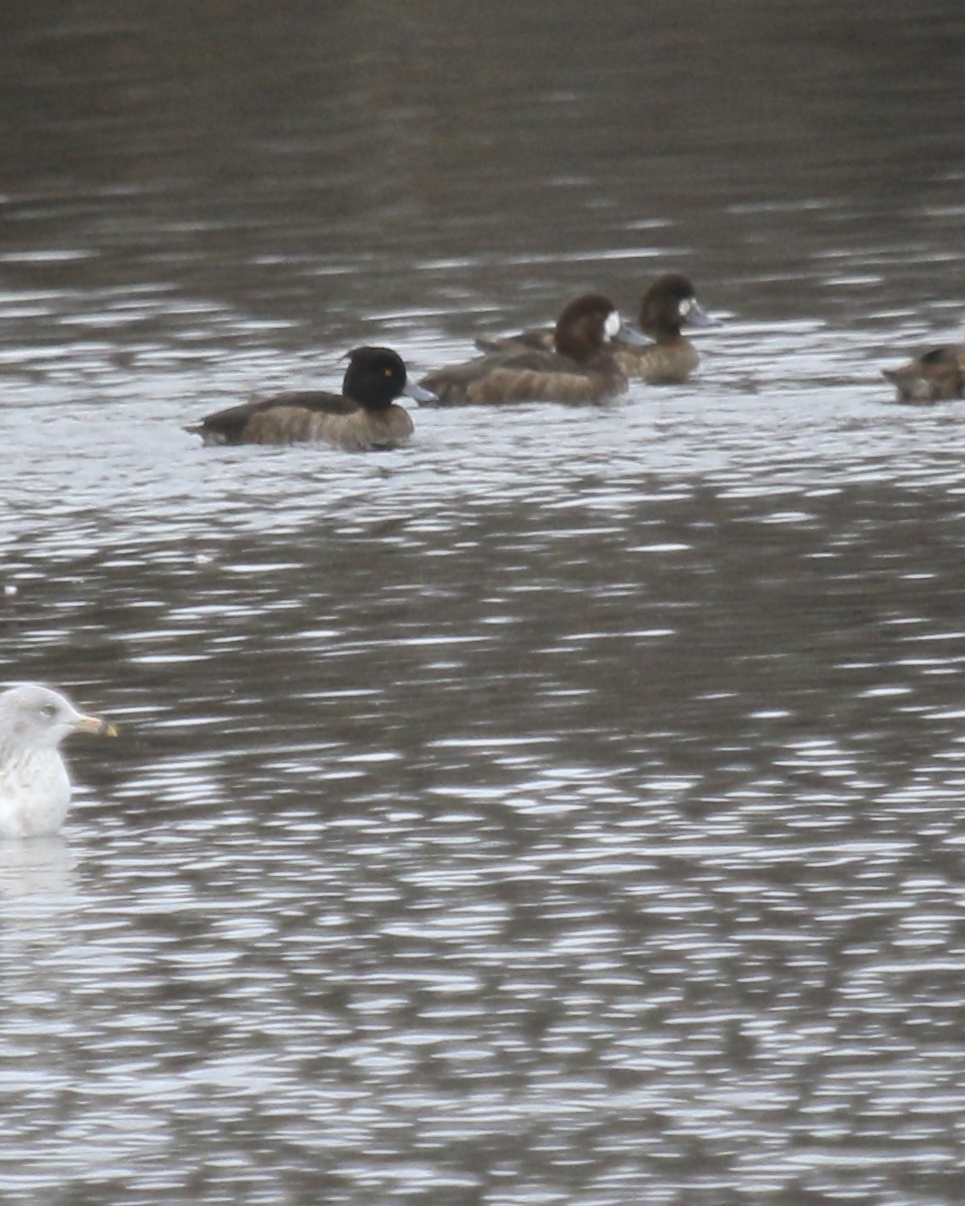
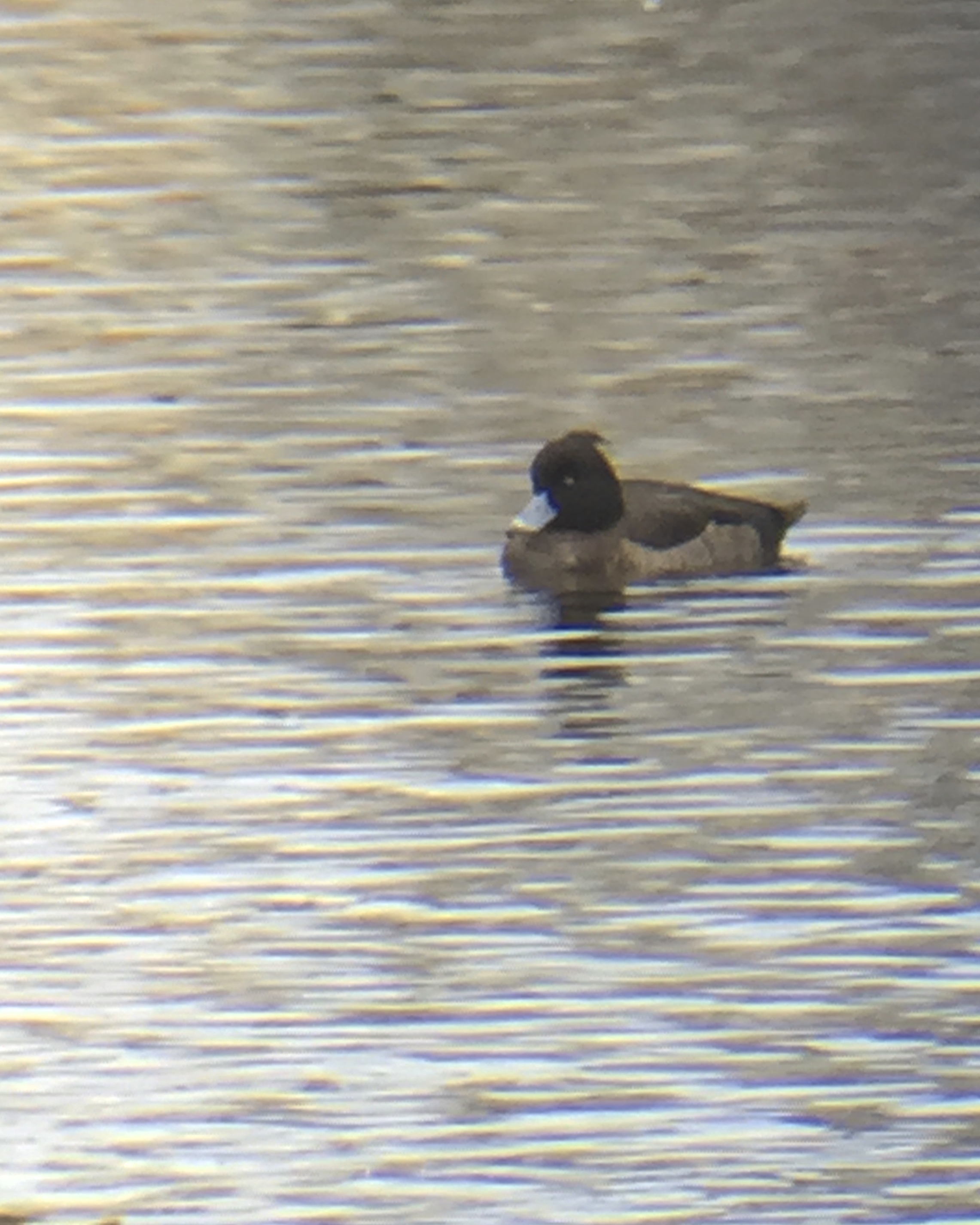
Tricia and I had a great time on Christmas Eve and Christmas day in Suffolk County, Long Island, celebrating with our families. On our way out of town today, we stopped at Lake Capri in West Islip to try for the Tufted Duck that has been reported there. The earliest reports on eBird are from 12/13/15, and the most recent report was from Christmas Eve, so I was feeling confident that the bird would still be present. Shortly after arriving, we realized that viewing at Lake Capri is less than ideal. As far as we could tell, the only viewing area was along Montauk Highway at the south end of the lake. There is a chain link fence and much vegetation to look through, which made viewing and taking photos a little bit of a challenge. I did better capturing the bird with my iPhone through the spotting scope, but for them the photo quality is then pretty poor. Previous reports indicate that this is a young male TUDU; it is a beautiful bird and life bird #344 for me.
~Here’s an iPhone shot of the Tufted Duck, digiscoped through my spotting scope. This shot almost has the feel of a painting to me. TUDU Lake Capri in West Islip, NY 12/26/15.~