Singing Grasshopper Sparrow on the AT near Route 94, in Vernon NJ, 6/ 27/14.
I was off work today, but I am in the middle of painting my house so I only got out very briefly this morning. I headed over to the Appalachian Trail where it intersects Route 94 in Vernon NJ. I was shown this spot last year by Judy Cinquina and the “New Jersey Crew” and I can’t thank them enough. It is a really great spot to bird this time of year, with GRASSHOPPER SPARROWS being the highlight. There were at least 2 present and likely a third. It is also an amazing place for Prairie Warblers, last year I only got distant looks, but this year I got much closer looks and some photos too. Finally, it is also a great place for Field Sparrows, with nice close looks.
GRSP at AT in Vernon, NJ, 6/27/14.Field Sparrow on the Appalachian Trail in Vernon, NJ, 6/27/14.I’ve been trying for a good Prairie Warbler shot all spring, I sort of like this one. AT at Route 94, 6/27/14.One more of the Grasshopper Sparrow. I love this bird. AT in Vernon NJ, 6/27/14.One of three Black-capped Chickadees. I haven’t gotten a good shot of one of these in a while. Appalachian Trail in Vernon NJ, 6/27/14.
Here’s my list for the day:
Great Blue Heron 1
Yellow-billed Cuckoo 1
Red-bellied Woodpecker 1
Willow Flycatcher 1
American Crow 2
Barn Swallow 5
Black-capped Chickadee 3
Wood Thrush 2
American Robin 4
Gray Catbird 4
Northern Mockingbird 2
European Starling 3
Prairie Warbler 6
Field Sparrow 6
Grasshopper Sparrow 2
Northern Cardinal 2
Indigo Bunting 2
Common Grackle 3
A Laughing Gull trails the ferry between Lewes DE and Cape May NJ, 6/15/14.
So, Tricia and I spent a three day weekend down at the shore, and although the trip did not revolve around birding, we got plenty in. Our first stop was in Rehoboth Beach Delaware, where we paid my Aunt Kathy and her wife Muriel a long overdue visit. We had a great time while we were there and we all did some birding early Saturday afternoon while walking the newly completed trail in Cape Henlopen State Park that connects Rehoboth Beach to Lewes.
CAPE HENLOPEN STATE PARK, 6/14/14
We were not on the trail very long when we had one of the highlights of the day – I reached a birding milestone by seeing my 300th life bird, which happened to be a Blue Grosbeak:
I would have liked to get a better shot of my 300th lifer, but the early afternoon sun was a bit harsh, so this is my best effort. We were excited to see good numbers of Snowy Egrets, several Osprey, and a single Black Skimmer. There were many terns present, and I believe most of them were Forster’s Terns, with at least one Common Tern also. These are not birds that I am very familiar with, so there is a lot of uncertainty there. Willets were numerous and often in close enough for photos:
Another highlight of the afternoon was second life bird for me which also presented the best photo op of the day: a Brown-headed Nuthatch.
CAPE MAY POINT STATE PARK, 6/16/14
On Sunday, the only birding we did was during the ferry from Lewes DE to Cape May NJ. The only noteworthy birds during the ferry ride were three likely Wilson’s Storm-petrels. I say likely because these are birds that I have no experience with. Looks were very distant and at the time I had no idea what they could be. I snapped some ID shots with the camera and later found out that the Wilson’s is the most likely storm-petrel to be seen on those waters, and also that their flight style, which is low and back and forth across the water stopping from time to time, helps to rule out Leach’s Storm-petrel (which flies more like a nighthawk with deep jerky wingbeats).
Monday morning we headed over to Cape May Point State Park and walked the trails for a bit, where the highlight was a tern I could actually identify. We had a single BLACK TERN that proved to be one of the most difficult birds I’ve ever tried to photograph. For some reason, when that bird was in flight, my camera could not distinguish it from the background. The result was MANY blurry photos. And, even if the bird was in focus, it was tough to get the catch light in the bird’s eye. Anyway, enough whining about it, here are my best shots:
While shooting the Black Tern, we also had a Great Egret come in close:
EDWIN B. FORSYTHE NATIONAL WILDLIFE REFUGE, 6/16/14
The Edwin B. Forsythe NWR was by far our most productive birding of the weekend. Things started out well when just off the dock at the start of the loop, we got super looks at a Marsh Wren doing the splits:
Moments later we saw a pair of CLAPPER RAILS, yet another life bird for the weekend:
As we started our way around the loop, I was hearing a call that I’d never heard before. We stopped the car and I found the source: a SEASIDE SPARROW! Another life bird!
We continued around the loop and although we did not have any out of the ordinary birds, we got plenty of great looks at some fabulous birds. I finally got a decent shot of a tern, I believe this is Forster’s Tern:
I also got decent shots of a couple of my favorites; a Black-crowned Night Heron and a Glossy Ibis.
Most of the way around the loop, I was hoping for a close look at a BLACK SKIMMER. Finally, while shooting the above night heron, a skimmer flew in nearby…
…and I was able to get a shot of it doing its thing:
What a great weekend with some awesome birds! It was a shame for it to be over and have to drive home on a Sunday night…
UPDATE: I’ve been sick all day with a sore throat/cold thing, so I did not get through the weekend’s photos. Hopefully I can finish them up and post tomorrow…
Tricia and I spent a three day weekend down at the shore, mixing some birding in with a nice getaway. We hit Cape Henlopen State Park in Rehoboth Beach DE, Cape May Point State Park, and the Edwin B. Forsythe National Wildlife Refuge in Galloway, NJ. I took a TON of photos, so it will take some time to sift through them all. I hope to have a complete post together for tomorrow night, but we shall see. Until then, here is my lifer CLAPPER RAIL, one of the first birds we saw at the Edwin B. Forsythe NWR:
My lifer Clapper Rail at the Edwin B. Forsythe NWR, 6/16/14.This was the second of five (!) Clapper Rails that we saw for the day. Edwin B. Forsythe NWR, 6/16/14.
Swamp Sparrow singing in the rain, Appalachian Trail Pochuck Section, 6/12/14.
After work today I walked the Appalachian Trail Pochuck Section for the first time this year. I had forgotten how good the trail was for Swamp Sparrows, so in spite of the poor light and the rain I got some decent shots. I was hoping that the Marsh Wrens would have nested near the boardwalk like they did last year, but no such luck. In addition to the the SWSPs and MAWRs, all the birds I saw were expected species, with a highlight being a couple of Green Herons.
I love the long legs on these Swamp Sparrows. AT Pochuck Section, 6/12/14.SWSPs are a beautiful sparrow, I love the colors on the back of this bird.Swamp Sparrow at the AT Pochuck Section, 6/12/14.
This Bobolink carried around these two worms for quite a while – perhaps a way to attract a mate? Shawangunk Grasslands NWR, 6/8/14.
QUICK POST TODAY: I walked the trails out at Shawangunk Grasslands this morning with Karen Miller, Linda Scrima, Maria Loukeris, and Sharon Scavotto. We all did well with many photos of Bobolink and Savannah Sparrows. Grasshopper Sparrows were heard and seen, but with distant looks. Eastern Meadowlarks were mostly heard, though we did see a handful, but again nothing in close. No American Kestrels were seen by the group in the three hours we were there, and no Upland Sandpipers either. We did get an Upland Sandpiper on our way home – perched on a fence post. It was a distant but good look and I believe it was a life bird for everyone in the group except myself. It was a successful morning of birding and bird photography – I can’t wait to see everyone’s shots.
I was happy to get a little bit of a different look – Bobolink on the rocks, Shawangunk Grasslands NWR, 6/8/14.Savannah Sparrow on the trail, Shawangunk Grasslands NWR, 6/8/14.Savannah Sparrow, Shawangunk Grasslands NWR, 6/8/14.A more typical look at a male Bobolink, Shawangunk Grasslands NWR, 6/8/14.
An early morning Grasshopper Sparrow out at Shawangunk Grasslands NWR, 6/1/14.
I finally made it out to one of my favorite places to bird this weekend – the Shawangunk Grasslands. On Saturday evening, Tricia and I met Karen Miller out there for a brief visit before going out to dinner. Then, I made it back out this morning and for over three hours, I walked the trails (which are now called the Tabor Trace – named for Ralph Tabor who does everything that needs to be done out there). It is a great time of year to be at the grasslands, the place is loaded with great birds: Bobolinks, Eastern Meadowlarks, and Savannah Sparrows are numerous and offer plenty of photo opportunities. There is also the possibility to see fantastic birds like Upland Sandpipers and Grasshopper Sparrows, and these two species were at the top of my list this morning. My best birds at the grasslands were by far the 4 GRASSHOPPER SPARROWS I had out there. The highlight of the day, however, did not occur at the grasslands. There is a spot, not far from the grasslands, that is good for getting Upland Sandpipers. I followed Ralph, Scotty Baldinger, and Gene McGarry over, and Ralph immediately located an UPLAND SANDPIPER! I jumped out of the car to see the bird and get some photos. Sadly, I am disappointed in my results, but still it was great to get such a good look at the bird. Shortly after that, Ralph and Scotty moved further up the road and located 2 more UPLAND SANDPIPERS! They were a bit distant for photos but still awesome to see.
Super bird, lousy photo. One of three UPLAND SANDPIPERS today in Ulster County – 6/1/14.
I did better with photos while I was at the grasslands, so here they are, by species:
A very cooperative Yellow-billed Cuckoo, Wallkill River NWR, Liberty Loop Trail, 5/26/14.
I went out this morning with the main goal of trying to get some cuckoo photos. I think both cuckoos that we get in the area (Yellow-billed and Black-billed) are fascinating birds; such large beautiful birds with exotic calls that I somehow never saw or heard my whole life until the last few years. My first stop was at the Wallkill River National Wildlife Refuge Winding Waters Trail, where Linda Scrima had located a Yellow-billed Cuckoo the night before. On my way out on the trail I heard a YBCU but did not see it. On my way back I located the bird easily when it called from a stand of bare trees. Huge thanks to Linda for the heads up, here is a shot of that bird:
Yellow-billed Cuckoo on the Winding Waters Trail at Wallkill River NWR, 5/26/14.
Afterwards, I headed over to the Liberty Loop to meet up with Maria Loukeris. We walked the loop; I was hoping for some shorebirds somewhere along the way. Shorebirds were not in abundance (Semipalmated Plover-2, Greater Yellowlegs-2, Spotted Sandpiper-1, Solitary Sandpiper-1, and Maria saw what were likely the Semipalmated Sandpipers that I had out there the other night- maybe 20 of them?). The poor showing of shorebirds was more than made up for by a pair of cooperative Yellow-billed Cuckoos in the southwest corner of the loop, right in the area of the eagle’s nest. I believe this was the first time Maria had seen YBCU, and we both took many photos. My best effort is at the top of this post.
A Beautiful Blackburnian Warble at Pochuk Mountain State Forest, 5/11/14.
POCHUK MOUNTAIN STATE FOREST
I got a little bit of a late start this morning, arriving at Pochuk Mountain State Forest at just after 8:00. I headed up the trail, and not too far along, I ran into Linda Scrima and Maria Loukeris. They were kind enough to let me join them and we had a very productive morning with many birds and plenty of photo opportunities. I particularly enjoyed getting some decent Scarlet Tanager and Blackburnian Warbler photos. I struggled as usual with many warbler identifications, but with the help of looking at photos later, I compiled my list of birds:
We got some amazing looks at Scarlet Tanagers, a bird that has evaded me up until today. Pochuk Mountain State Forest, 5/11/14.
Canada Goose
Turkey Vulture
Red-bellied Woodpecker
Downy Woodpecker
Eastern Wood-Pewee
Blue-headed Vireo
Blue Jay
Wood Thrush
American Robin
Gray Catbird
Ovenbird
Common Yellowthroat
American Redstart
Magnolia Warbler
Blackburnian Warbler
Chestnut-sided Warbler
Black-throated Blue Warbler
Pine Warbler
Black-throated Green Warbler
Scarlet Tanager
Northern Cardinal
Rose-breasted Grosbeak
Indigo Bunting
Baltimore Oriole
Additionally, I am pretty sure that Maria had a Blue-winged Warbler as well; she sent over a photo that looks like a pretty good ID for the bird. Linda and Maria – let me know what other species I’ve left off the list! Thanks.
Chestnut-sided Warbler at Pochuk Mountain State Forest, 5/11/14.Magnolia Warbler at Pochuk Mountain State Forest, 5/11/14.Blackburnian Warbler in flight, Pochuk Mountain State Forest, 5/11/14.One more Scarlet Tanager shot – what a gorgeous bird. Pochuk Mountain State Forest, 5/11/14.
WALLKILL RIVER NATIONAL WILDLIFE REFUGE
Maria headed home and Linda and I continued over to the Winding Waters Trail at Wallkill River NWR. It was getting a bit late and there were not as many warblers present, but we still did pretty well, particularly with raptors, seeing: Bald Eagle, Turkey Vulture, Cooper’s Hawk, Red-tailed Hawk, and Red-shouldered Hawk! Here’s my list, which includes a couple of birds I got when I walked out Liberty Lane briefly afterwards:
My FOS Orchard Oriole at Winding Waters Trail, 5/11/14.Great-crested Flycatcher at Winding Waters Trail, 5/11/14.
Canada Goose
Mallard
Turkey Vulture
Cooper’s Hawk
Bald Eagle
Red-shouldered Hawk
Red-tailed Hawk
Killdeer
Spotted Sandpiper
Mourning Dove
Great Crested Flycatcher
Warbling Vireo
Blue Jay
American Crow
Tree Swallow
Barn Swallow
Tufted Titmouse
House Wren
Ruby-crowned Kinglet
Eastern Bluebird
Wood Thrush
American Robin
Gray Catbird
European Starling
Ovenbird
Common Yellowthroat
Yellow Warbler
Yellow-rumped Warbler
Song Sparrow
Swamp Sparrow
Indigo Bunting
Red-winged Blackbird
Common Grackle
Orchard Oriole
Baltimore Oriole
American Goldfinch
A female Common Yellowthroat in the shade. Wallkill River NWR, 5/11/14.
This Blue-gray Gnatcatcher is hopefully the last photo I will post using my 55-250mm lens for a long time – I got my 100-400mm lens back today. I took some test shots in the Canon parking lot and the lens seems to be working well, but I will know for sure once I take a look at the shots on the computer. This gnatcatcher was shot at Sterling Forest on Monday 5/5/14 in the afternoon. It was not very birdy out there at that time, but I am pretty sure you can do well for warblers there in the early morning.
Five of the 25 Caspian Terns we had at Montezuma NWR, 4/19/14.
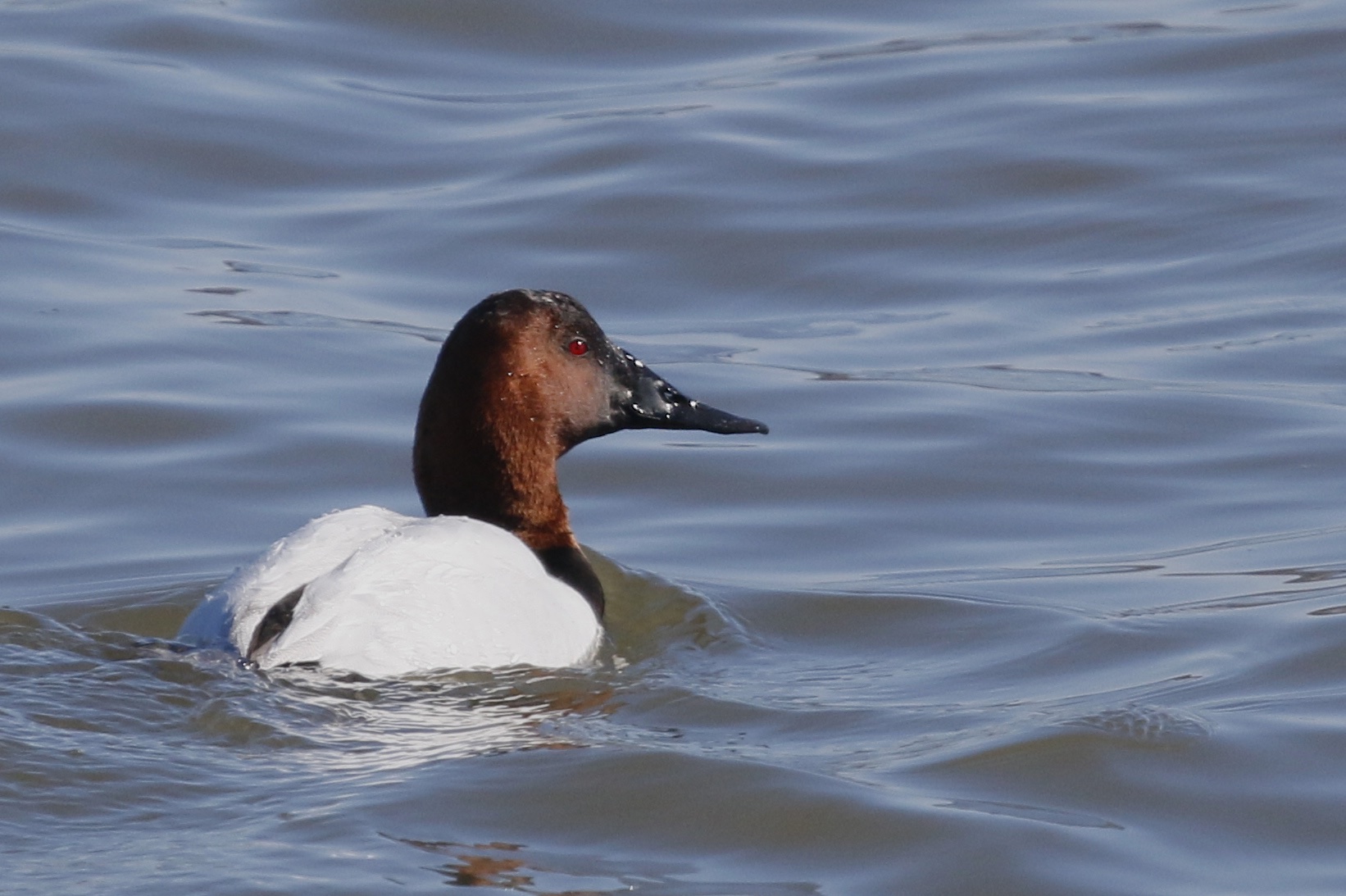
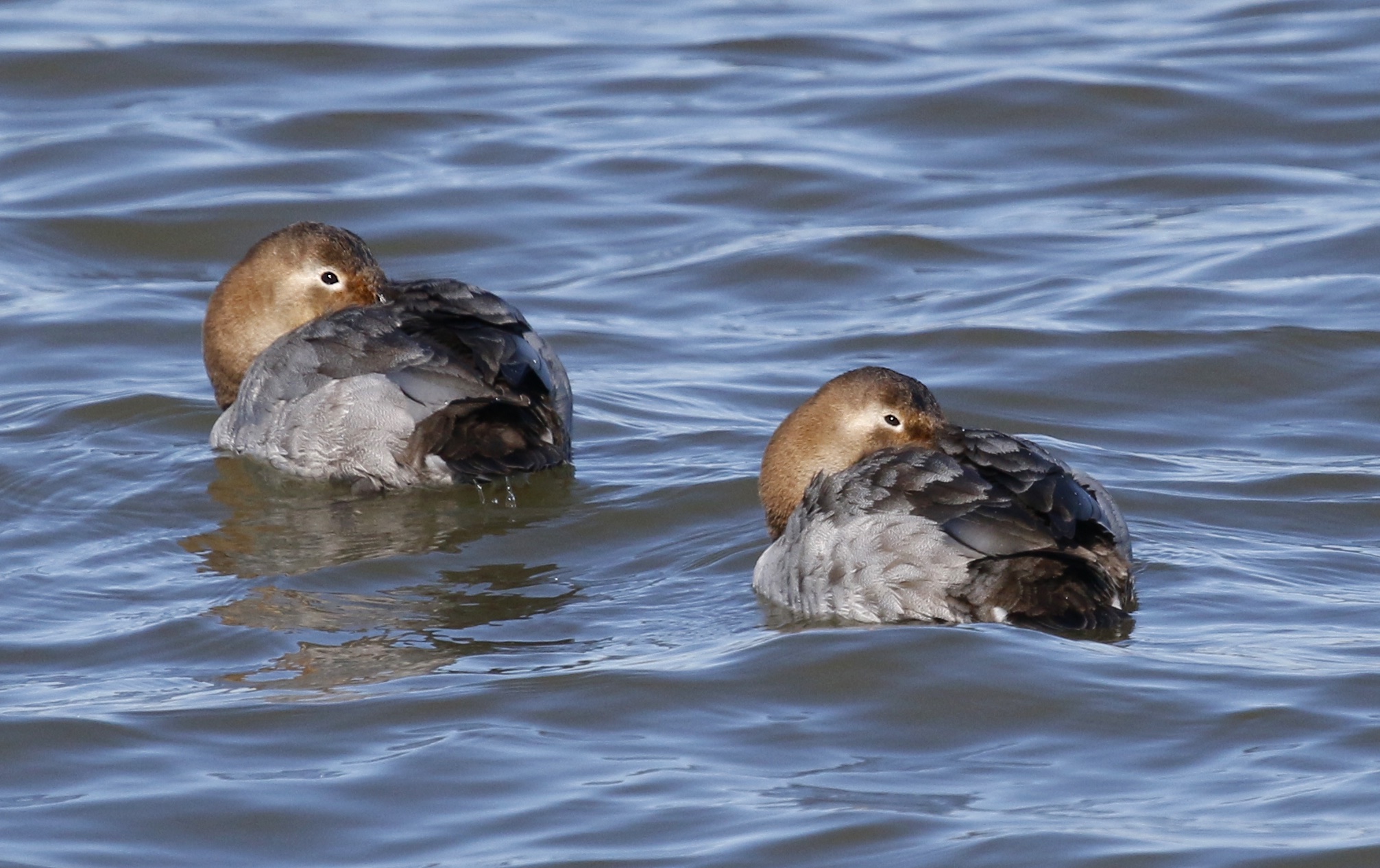
If you get the chance to go to Montezuma National Wildlife Refuge, by all means go. I have never been disappointed at this refuge. This past Saturday morning, Bill Martocci and I left Baldwinsville (where Tricia’s mom lives), and arrived at Montezuma just before noon. The timing could not have been more perfect for me because most of the waterfowl had recently moved out of Orange County, and to be honest, I just hadn’t gotten enough of them. At Montezuma, there was still a super showing of waterfowl, and if you include all swimming water birds, we totaled 17 species, including nearly a dozen CANVASBACK, which was a life bird for me:
I always seem to be shooting Blue-winged Teal through the grasses. Montezuma NWR, 4/19/14.
I like this shot of an American Coot, which is not a very photogenic bird in my experience. Montezuma NWR, 4/19/14.Northern Shoveler at Montezuma NWR, 4/19/14.
It also seems to be the year of the Caspian Tern – we had 25 at the refuge, 22 of which were located perched just outside the visitor center. For the weekend, I would guess that I had close to 35 Caspian Terns in the area!
A Caspian Tern (with blown highlights) in flight. Baldwinsville, NY 4/20/14.
The highlight of the day for me, however, was locating an AMERICAN BITTERN. At the visitor center, we talked to a local birder who made us aware that he had had a bittern earlier that day. That helped, because I was certainly on the lookout. We had stopped to look at a large flock of Tree Swallows when I located the bird of the day. I really struggled taking photos; I think the camera has a difficult time focusing on this bird because of how well it is camouflaged. While looking at and shooting this bird, each time I looked down I would lose track of where the bird was.
AMERICAN BITTERN at Montezuma NWR, 4/19/14.I love this pose. AMBI at Montezuma NWR, 4/19/14.
Highlights for Bill included seeing a handful of Bald Eagles, a Belted Kingfisher, and a very brief glimpse of a female American Kestrel. We missed out on at least a couple of birds I was hoping for, including Sandhill Crane, Trumpeter Swan (both of which were reported at the refuge that day!), and Tundra Swan which have likely moved through at this point. It was a great day of birding where we totaled over 40 species.
I had to throw this photo into this post. This was taken at a small pond in Tricia’s mom’s neighborhood, typically a pond that has few birds. 4/20/14.